Author: Nibwene

  • Rethinking John Green

    I spend my days in sketchy corners of Twitter and YouTube where I get triggered to write about topics that probably no one cares about. But it’s fun so here we are.

    “To weird”, he said.

    “To weird,” we clinked cans and sipped

    Turtles All the Way Down, John Green

    I read a tweet about a year ago (now deleted) about how similar John Green novels are. I felt so embarrassed because when I was 17 John Green was the Peter Van Houten to my Hazel Grace Lancaster, pre-Amsterdam trip. I once borrowed four, yes 4, John Green novels from my high school library. Paper Towns, An Abundance of Katherines, Will Grayson, Will Grayson, and The Fault In Our Stars. I read all except Will Grayson, Will Grayson because I couldn’t keep up with the weird two-author format. Years later I read Looking for Alaska and Turtles All The Way Down. It’s been nearly two years since I read the most recent one, Turtles All the Way Down and so, I’ve had plenty of time to think about John Green’s works.

    It’s true, they are all very similar. I read the same book multiple times and the only thing I can say to defend myself is that John Green’s books are very, very quotable and I love quotes.

    So let me give a summary of the books, without giving away too much, just for context.

    Looking for Alaska follows a teenage boy (Miles) who seeks a profound meaning/experience in his life. He falls for a girl, Alaska and he tries to understand her.

    Paper Towns follows a teenage boy (Quentin) who is fascinated by a girl, Margo Roth Spiegelman, who is considered to be this cool girl that everyone wants to be or be friends with.

    An Abundance of Katherines follows a teenage boy (Colin) trying to be a genius by attempting to discover something. So he comes up with a formula that predicts how long his relationships with girls named Katherine lasts (he’s dated like 20 of them…).

    The Fault In Our Stars is the most known John Green book. It’s about a teenage girl with cancer who falls for a teenage boy who also had/has cancer and is dying. They bond over their love for a novel called An Imperial Affliction by Peter Van Houten.

    Turtles All the Way Down. For a while, maybe two years, this was my favorite book. In this book, John Green writes about Aza Holmes, a teenager with obsessive-compulsive disorder (OCD).

    Similar plotlines

    When reading Looking for Alaska and Paper Towns I got the impression that life is about chasing something great, unusual, and perhaps even unreachable. Both Miles and Quentin are trying to find a girl (Alaska and Margo). John Green starts both stories with a Tumblresque quote signaling the story’s direction. The “signal quote” is placed somewhere in the first few pages.

    “The way I figure it, everyone gets a miracle…But my miracle was different. My miracle was this: out of all the subdivisions in all of Florida, Indeed up living next door to Margo Roth Spiegelman.” (Quentin, Paper Towns)

    “So this guy, François Rabelais. He was this poet. And his last words were, ‘I go to seek a Great Perhaps.’ That’s why I’m going. So I don’t have to wait until I die to start seeking a Great Perhaps.” (Miles/Pudge, Looking for Alaska)

    It comes to no surprise that both stories are centered around a girl. The thing about Alaska and Margo is that they are very, very similar. Popularity, beauty and quirky habits are characters that both have. On the other hand, Miles and Quentin are generally irrelevant in their schools. They’re nobodys who want to save themselves from their situations and think that this girl(s) is the Great Perhaps, the Miracle, the answer, etc.

    John Green writes things like, “If people were rain, I was drizzle and she was a hurricane.” (Miles/Pudge, Looking for Alaska). Drizzle wishes it was always followed by a hurricane so that it could mean something in the world precipitation. Instead, it’s just drizzle. Even the Weather app doesn’t pick it up sometimes. It wants to be seen and to mean something and so it seeks its hurricane; its great perhaps. Do you see the problem with this?

    It ties into the whole discussion about Manic Pixie Dream Girls in literature, mostly film and TV. Basically, a MPDG is a free-spirited character (female) with a peculiar background or habits that draw the (usually male) protagonist towards them. The male protagonist is always in love with the MPDG and she exists to teach the protagonist some grand lesson. Alaska is there to show Miles that life shouldn’t be taken so seriously. She says cringey things like “Y’all smoke to enjoy it. I smoke to die.” Look, I get it. Teenagers have mental illnesses that push them to make questionable life choices. We’ve all been there. But this line…really, John? Oh and just before that, he writes, “She looked at me and smiled widely, and such a wide smile on her narrow face might have looked goofy were it not for the unimpeachably elegant green in her eyes. She smiled with all the delight of a kid on Christmas morning…” Really? The problem here is that it’s not just one or two sentences. It’s the whole book. You find parts like these describing the MPDG (Alaska or Margo). In another part he writes, “…she (Alaska) was beautiful. In the dark beside me, she smelled of sweat and sunshine and vanilla.” Yes, sweat. It’s almost as if these protagonists have literally nothing going on for themselves and that is why their stories center around these MPDGs.

    Let’s look at Paper Towns and how Quentin actually spent days searching for clues about where Margo is and then he goes on a road trip to find Margo who had ran away from home just before the end of high school. The same Margo who he barely hung out with. She had her own social life with friends and a boyfriend, until he cheated on her, and then she suddenly shows up at Quentin’s window asking for help in her immature middle-of-the-night revenge scheme as if the entire 9 years where they barely talked hadn’t happened. Regardless, Quentin felt that he needed to do what he did. The entire book is him trying to figure out where she went and then actually dragging his friends on a long road trip from Florida to New York. But what does Quentin have outside of his Margo obsession? Nothing. She’s his “miracle” and the strangest thing is that we barely learn anything about her in the book. She’s only there to reveal to him that paper towns like theirs only look good from the outside. “…everything’s uglier up close”. I guess she’s there to make sense of the book’s title. Even though the book is mostly about her and paper towns get mentioned very few times.

    Characters of color

    This is a touchy topic. Personally I don’t care if a book lacks diversity among its characters, especially if it’s set in what can be assumed to be a predominantly white society. I do, however, think it’s ridiculous to include non-white characters for shallow comedic plotlines. This is a common feature in John Green’s books.

    In An Abundance of Katherines you have Hassan who is of Arab origin, in Paper Towns Marcus is black and Daisy Ramirez is obviously latina, in Turtles All the Way Down.

    Hassan serves as Colin’s sidekick in An Abundance of Katherines, he’s written in a way that doesn’t make you care much about him even though he’s always there. I can’t even remember anything significant about him other than something to do with baguettes. In Paper Towns, Quentin mistakenly buys a confederate flag T-shirt for Marcus while on their road trip to New York, and it’s all resolved as a small funny mistake. Also it is mentioned somewhere (or maybe multiple places) in the book that Marcus’ parents own a large collection of black Santas. I know: what? In Turtles All the Way Down, Daisy says things like, “I have the soul of a private jet owner, and the life of a public transportation rider”, and in reference to being asked why she used past tense in a conversation about Star Wars, she says, “Because all of this happened a long time ago in a galaxy far, far away, Holmesy. You always use the past tense when talking about Star Wars. Duh.” I love Star Wars, but this is a bit cringey.

    After reading Turtles All the Way Down I realized that Aza is just a female version of Colin from An Abundance of Katherines. She and him are seemingly calm and sensible in comparison to their best friends, i.e. Daisy and Hassan, who tend to be very out there with this and that. Like Hassan, Daisy comes off as a rebel who is there to bend societal codes of conduct in order to get what she wants. Hassan is self-proclaimed slacker, whereas Daisy convinces Aza to participate in her plan to win a reward for information about the fugitive billionaire, Mr. Picket, and she uses Aza’s connection to Mr. Picket’s son, Davis, to do that.

    Again, pointless plotlines that make them come off as ridiculous characters in comparison to the protagonists, and, as a matter of fact, every other character.

    The writing

    If you’re a regular here (thanks by the way), you might’ve noticed that I tend to use a lot of John Green quotes in my writing. There’s here, here, here and here.

    I love John Green’s quotes, I won’t lie. However, it comes off as if his books are repetitive pop albums where every song was carefully crafted to be on the Billboard Hot 100. I don’t read much, but I’ve read enough to see that John Green’s novels have an unusually high number of quotable lines. I mean, I even wrote this. It’s almost like he knows there’s a niche for his words somewhere on the internet: Tumblr. There’s an attempt to be profound and interesting, but it has been done so many times throughout his writing career that it has gotten old and boring.

    Quotes like “I go to seek a great perhaps” and “everyone gets a miracle” make it seem like there’s something more to life than what we have right now. I don’t know about others, but when I read most of these books between the ages 17 and 20, I found myself wishing I could escape to an unknown place or that I could find someone to help me escape the little labyrinth that I felt I was living in. That stopped me from living in the moment and I spent my days in my room dreaming of what couldn’t be. Frankly, I’m tired of running away from places and as I figured last year, the only miracle I get in life is being able to do what I can do; the daily mundane tasks and not-so-mundane ones like writing that allow me to grow. Really, life is that simple; a complete opposite of what a John Green quote/book will try to tell you.

    I think John Green is smart in the way he uses words. I love that. He makes me feel things when I read his works, depending on the situation I’m in. I remember saying “pain demands to be felt” to myself over and over, back in my teenage depression days. That quote still gets me through things. But as a novelist, I know now that he is basic. There isn’t much to think about when you read most of his books. The plots tend to be shallow, especially considering how some of these stories focus on the protagonist’s female love interests who we don’t learn anything significant about. Despite the quotes and the very vivid descriptions of physical beauty, Margo and Alaska are still two very mysterious and unknown people.

    The Fault In Our Stars was John Green’s best work. It has its flaws (kissing in the Anne Frank House???), but is different from the rest. TFIOS is just two people who are uniquely compatible and they fall in love despite both of their lives literally hanging by a thread. No one is seeking the other to find themselves. Each is a whole person wanting to love someone else. Very matured when compared to the likes of Colin, Miles and Quentin whose entire personalities are based on finding/understanding girls who each think is his better half. The most impressive thing in TFIOS, to me, is Augustus’ character development where he later understands that he is not a nobody after all. Someone cares about him and even though it isn’t a hurricane of people building monuments and naming streets after him, the terminally ill drizzle that admires him is still precipitation and that’s all that matters.
  • This time for Africa, again.

    Black Is King was controversial from the moment its trailer was released and now even after the film was released on Disney+, there has been a lot of criticism regarding its depiction of Africa and the way Beyonce chooses to celebrate or uplift Africa and African heritage through her art. In this very long essay, I decided to look into some of the issues that have been brought up in discussions about Black Is King, in addition to others that I observed while watching it.

    Inauthenticity

    Following the release of The Lion King live-action remake in 2019, there was a lot of controversy regarding Beyonce’s album The Lion King: The Gift which was inspired by the film and featured several afrobeats tracks. The controversy was because we, East Africans (referring to Tanzania, Kenya, mainly) found it confusing that Beyonce would use our language (Swahili) in an album inspired by a film that is said to be set in East Africa and not include any East African artists. Instead, the album featured some West African and South African artists like Wizkid from Nigeria and Moonchild from South Africa. You can even see a shot of Mount Kilimanjaro in one of the scenes, the characters’ names are Swahili words; Simba, Rafiki, Kovu, Shenzi, Pumbaa, and even the most famous phrase from the film “hakuna matata” is Swahili. So why weren’t any Swahili-speaking artists considered for the album and the film that followed?

    I’ve seen a lot of Beyonce fans who say that she did her research and therefore knew what she was doing, but I don’t think that is true here. We can let go (I think) of The Gift, but they had a whole year to work on Black Is King, a retelling of The Lion King story, and not once did someone say, ‘hey since this story is set in East Africa it’ll be more authentic to include East African artists’? They didn’t do that and it just shows that research wasn’t done. It also perpetuates the idea that African culture is something homogeneous and therefore a story set in East Africa can feature West African and South African artists. Some might argue that afrobeats (a genre that is included in Black Is King) is African, so it doesn’t matter. But it does matter. Afrobeats is a West African music genre. It is quite popular in many African countries and elsewhere, but other Africans are avid listeners of music that is native to their regions. For example, in East Africa, Bongo Flava is the most popular music genre. Therefore the perfect features would’ve been Sauti Sol, Mrisho Mpoto, Diamond Platnumz (Simba himself, that’s what he and his fans call him), Saida Karoli, Jose Chameleon, Vanessa Mdee, Nandy, Navy Kenzo, and others.

    Of course, at the end of the day, it is Beyonce’s album so she can do whatever. But in the spirit of educating about Africa, such authenticity should be expected, especially from big global artists like Beyonce.

    African religions

    Black Is King features elements of some African religions. These include calling on ancestors and the use of headpieces that resemble some ancient Egyptian goddess and others. This has brought up the debate on the respectability of African religions and spirituality, i.e. those that existed before Islam and Christianity were brought by “the Arab and the white man”.

    Islam has existed in Africa (Horn of Africa region: present-day Ethiopia, Eritrea) since the 7th century. Christianity has existed in Africa since the first century. That’s a really long time ago, and yes, it is a different version of Christianity from what is practiced in most African countries today, but it’s still Christianity. So we can say that both Islam and Christianity are in fact African religions.

    The debate usually involves the word ‘traditional’, and ‘traditional’ refers to something that has existed for a long time. While taking this meaning into account, all forms of spirituality together with Islam and Christianity are traditional African religions, because in reality there is no specific time period after which we get to decide if something is traditional, but the time gap between the 7th century and today is quite big and even bigger if you consider the 1st century and today. We can’t just exclude certain things because they don’t fit the narrative that we are trying to create. The truth is Islam and Christianity are just as African as whatever existed before them.

    It is also important to acknowledge that both Islam and Christianity were later spread across Africa through brutal means, i.e. jihads and European colonialism. I have seen tweets claiming that demonizing African religions (with the exclusion of Islam and Christianity) and spirituality is anti-black. Jihads in West Africa were carried out by the Fulani/Fula Muslims. The Fulani are a West African ethnic group of black people. This contradicts the anti-black claims. I’m not sure if the Fulani were forcibly converted, but they did forcibly converted others so these jihads were the result of black people’s actions and so that contradicts the claim that choosing to align with “non-African” religions such as Islam is anti-black.

    A good number of Africans today are either Christian or Muslim. These are monotheistic religions and so many who follow them don’t participate in other forms of worship. I have seen Africans getting attacked for speaking against the polytheistic African religions or for stating why they have chosen to stay away from these beliefs. Some of the attacks say that we are brainwashed by “the Arab man and white man”. I agree that most of us became Christian or Muslim as a result of external influence, but saying that we are brainwashed is an insult to us Africans because this assumes that Africans lack agency. Either we know what these other religions can do and we want no part in it, or for some, Christianity and/or Islam are just as African, because as mentioned before, they have existed in the continent for quite some time.

    Black royalty and related tropes

    Black Is King (Disney 2020)

    The Lion King is a story about royalty, but to some, it seems like Black Is King is playing into the “we were kings” narrative. This narrative was adopted into the mainstream discourse about European colonialism in Africa. It came during a time when many Africans, especially those outside of Africa, were trying to show that Africa wasn’t a backward isolated ditch where black people lived and therefore European colonialism was not needed. I fully agree with this because if other societies, including European societies, could move past slavery, feudalism, and pointless religious wars, then so could Africa – on its own. However, the African/black royalty narrative has gotten to a point where it is being brought up not only in online debates but also in art, specifically in film. Here we refer to Marvel’s Black Panther and now Black Is King, which are the most popular recent films of such genre. Yes, the Black Panther story had already existed before the film was even made and Black Is King is a retelling of The Lion King, as mentioned before, but what does it tell us about society that these kinds of stories that use the black royalty trope and are centered around black people, are some of the most popular black films? Excluding these two, other popular stories that are centered around black people tend to be stories that exhibit an unbearable amount of black pain, i.e. American slavery (12 Years a Slave, The Birth of a Nation, Django Unchained, Precious), European colonialism in Africa (Tarzan, Mandela: Long Walk to Freedom) and chaos in post-colonial sub-Saharan Africa (Hotel Rwanda, The Last King of Scotland, Blood Diamond, Beasts of No Nation).

    Perhaps then there is a reason why African royalty in films is being celebrated. As black people, we are tired of being portrayed as slaves, helpless colonial populations and bloodthirsty armed rebels or corrupt political leaders. The African/black royal trope only serves as a reaction to misconceptions about Africa that had existed before, but it also has its problems. Nigerian author Chinua Achebe said (according to Africa as a Country), “I do not see that it is necessary for any people to prove to another that they built cathedrals or pyramids before they can be entitled to peace and safety. Flowing from that, I do not believe that black people should invent a great fictitious past in order to justify their human existence and dignity today.

    Chinua Achebe is right here. This is exactly what racism does to the oppressed. We end up spending decades and even generations trying to show racists that we too have a great history in order to prove them wrong or gain their respect. But that is not necessary. The great past (and it wasn’t great for every African society, by the way) is gone and for the most part, Africa today is quite messy. It’s pointless to put up photos of skyscrapers in Nairobi and elsewhere as a counter-point to “Africa is poor”. The truth is that many African countries are poor, even in urban areas where some of these skyscrapers and modern architecture exist, and the evidence isn’t hard to find. As an example, Nairobi has the largest urban slum in the continent: Kibera slum. We shouldn’t be focused on royalty, former greatness and carefully selected positive elements of modern Africa. Instead, we need to focus on the truth, i.e. reality. However, this is not to mean that works of art such as Black Panther and Black Is King should not exist.

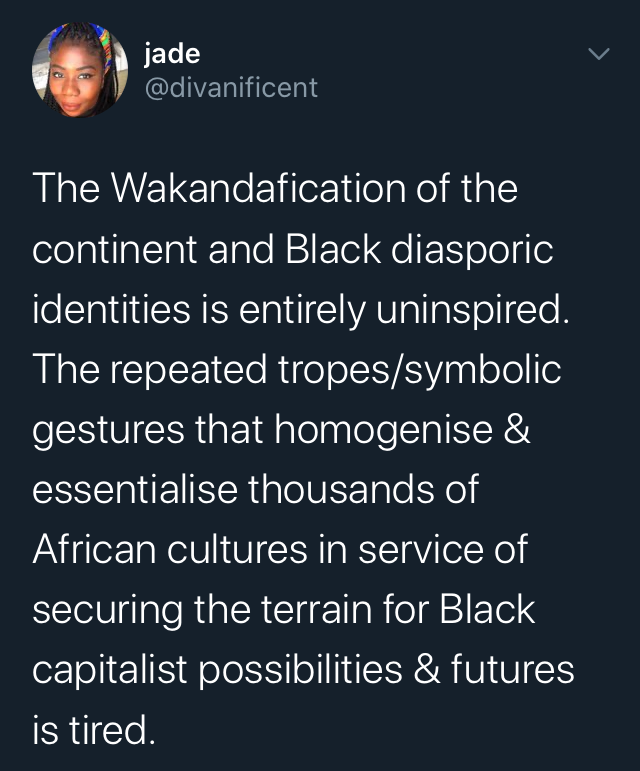
    We need more art that depicts everything; black royalty, black pain, black success (e.g. Dolemite Is My Name). But we also need to be careful about how we consume such works and how we carry the topics brought up by these works into the real world. Black Panther played itself. The film found itself trying to prove to racists that Africa isn’t all poor and desolate. When this particular message was taken into real life we found ourselves calling any African country that seems to be doing well, especially in regard to economic development and political order, Wakanda (e.g. Rwakanda to mean the seemingly organized and efficient Rwanda under President Kagame). This wakandafication tends to erase or simply ignore the pain and poverty that still exists in Africa in addition to the pain caused by these supposedly efficient yet authoritarian governments (e.g. Tanzania). But it could also be that such terms are meant to uplift and encourage other countries to do better. I’m sure it’s no one’s intention to do this, which is why we ought to be careful when bringing fiction into reality.

    Black Is King

    As a visual work of art, I think Black Is King has exceeded expectations. It is indeed satisfying to watch. I really loved the costume design and the evidently high-quality production. It did also do well in retelling The Lion King as a modern African story.

    The issue is what part of Africa needed to be represented in order for it to be authentic. As an East African who grew up in the continent, I feel very disconnected from it. The film reminds me of the need for East Africans to work on telling our own stories. We have a lot to offer, and we already do through Swahili, Bongo Flava, and other cultural elements, yet we are still largely excluded from the ongoing Africa “wave” even though it has shown to continuously exploit our region and its culture (Black Panther, The Lion King, Black Is King).

    Something interesting that I realized about Black Is King is that it does exactly what Binyavanga Wainaina wrote in his famous piece How to Write About Africa, “Subtitles may include the words… ‘Nile’, ‘Sky’, ‘Sun’…”. In the film, there’s a song titled NILE. Important to point out that the cultures depicted in the film are West and South African, so the mention of the Nile is somewhat irrelevant. Even in The Lion King, the Nile is nowhere to be found in the particular region of East Africa. The shots of Mount Kilimanjaro are proof. Wainaina also writes, “Don’t get bogged down with precise descriptions. Africa is big: fifty countries, 900 million people who are too busy starving and dying and warring and emigrating to read your book.” Sadly this is how it happened with Black Is King. The film wasn’t well-researched meaning it lacked attention to detail in relation to The Lion King story. It combined a few of many West and South African cultures to tell a story of Simba and co. most who have Swahili (East African) names. The saddest part is that no one at Disney thought to make this accessible to Africans (“…too busy starving and dying and warring and emigrating to read your book”). It was announced that it would air on M-net, which is available in nearly all African countries, however, it is important to mention that Mnet is accessible through DStv. As an African, I know that it’s mostly the upper and middle class who can afford DStv. Another thing Wainana writes is, “Wide empty spaces and game are critical – Africa is the Land of Wide Empty Spaces. This can be observed in the film itself (see image below).

    Black Is King (Disney 2020)

    To end this very long essay, I’ll leave a quote by Nelson Mandela that I think relates to some of what this essay touches on, because as Wainaina writes, “Always end your book with Nelson Mandela saying something about rainbows or renaissances. Because you care.”

    “If you talk to a man in a language he understands, that goes to his head. If you talk to him in his language, that goes to his heart.”

    Nelson Mandela
  • Wakandafication

    As usual, something happens on the internet and someone tweets about it and I say to myself, ‘that would make a great blog post topic’.

    I believe this is related to something Beyonce did or will be doing soon with Disney, but I’m not really a fan or a follower and I do not know anything significant about her work, so I will not comment on that. I’m here to have fun with different (but maybe similar?) arguments.

    If you’re not familiar with the term ‘Wakanda’, allow me to direct you to Marvel’s Black Panther film from 2018. A majority of the film is set in the fictional East African kingdom of Wakanda. Wakanda is exactly what the “Africa isn’t what you think it is” crew try to portray when they tell you that Africa isn’t what you think it is. It’s an African country that is still in touch with its roots because unlike others, it was never colonized. Wakanda still has poweful monarchies with political power and best of all, they figured out a way to use their most precious resource, the metal Vibranium, for their benefit. Wakanda’s technological capability is top in the Marvel universe. It is indeed a pan-Africanist’s fantasy, but that’s all that it is: a fantasy.

    Black Panther came out, many of us (people of African descent) hyped it up, it got an Oscar nomination (which it did not deserve, in MY opinion) and a few of its elements, like the “Wakanda Forever” salute made its way into mainstream media through hashtags, dances and memes. But something about the film lingered and I think it has stayed with us for too long.

    I remember going to Kigali, Rwanda in August 2018 and hearing someone call Rwanda ‘Rwakanda’. The nickname ‘Rwakanda’ was given to Rwanda because it’s said to be a hopeful African country. The cities are clean, things work (allegedly, I don’t know much to have a say on this) and several other progresses that have been made in the country, which are truly remarkable considering its recent history. The adoption of the nickname ‘Rwakanda’, even though not meant to be taken seriously, represents the wakandafication of real places in Africa by Africans (and others) in order to prove to the world that we are worthy of respect. It mirrors the common “we had kings and queens, we had great architecture…before European colonialism” narrative. This narrative tends to overromanticize pre-colonial Africa and glorify things which none of us actually know about very well. For instance, African societies didn’t just have monarchies, we still have them. They too are royal families with titles, but mostly without political power like many other royal families in European countries. The reason why we don’t hear about the African ones is the same reason why we want to prove that they once existed.

    Nigerian author Chinua Achebe wrote what I’m trying to say better:

    I do not see that it is necessary for any people to prove to another that they build cathedrals or pyramids before they can be entitled to peace and safety. Flowing from that, I do not believe that black people should invent a great fictitious past in order to justify their human existence and dignity today.

    Chinua Achebe. Also included in Africa Is a Country‘s post Beyoncé and the Heart of Darkness

    It’s almost as if we only want to be associated with Africa, or bring Africa to non-African spaces, if it is presented in a colonialism-never-happened-kinda-way. Wakandafication ignores the bad stuff, and reality. A good example is how conversations of ‘Rwakanda’ rarely acknowledge the undemocratic government in Rwanda. And for the democracy-doesn’t-work-in-Africa party, the ability to speak does not make you smart. It does, and it should.

    Wakandafication of Africa is the selection of desirable fictitious and real cultural elements, and their presentation in mainstream media as African and not as parts of different cultures in the continent. Wakandafication perpetuates the misconception of Africa as a country with a homogenuous culture and capitalizes on the pan-African idea that Africa is or should be one.

    Africa was never cool until Black Panther. Sometimes I think it still isn’t cool because most of what Africa is presented to be in mainstream media is just select unrelated elements of different African cultures that seem to give the idea that Africa is where it’s at, even though that is not true. (You may refer to a previous article I wrote on a similar topic). African countries, as they are, are not seen as desirable. Africa as a whole is, but only when given to the consumer in a way that makes them feel good about themselves; after wakandafication.

    Spirits, made-up rituals, lions, the savannah plains, rare minerals, etc. These are some of the things that make the cut during wakandafication. If we looked in a bit deeper we would know that spirits are not considered good in many parts of Africa because of their connection to witchcraft, which was never embraced in pre-colonial times, contrary to what some Twitter threads might try to tell you. In my tribe, for example, witches were explicitly bad because of their ability to cause harm to others, and that’s not on European colonialism. Some rituals like the one presented in Black Panther are just made-up and they are meant to be consumed as works of art and not to be brought into the real world as “our roots”. There were rituals before, but most of us don’t even know what they were, some of us don’t care to be honest, and it’s not anyone’s job to create new ones. Lions are being killed by poachers, read the news. The savannah plains are just the savannah plains and animals live there. Most are conservation spaces. Do they look good? Yes, but it’s very important to know the racist colonial history of these places. Rare minerals have become causes of human rights abuses, fraud and other crimes. I’m just trying to show what’s real.

    So, dear reader, things are not how we want them to be. I would love it if there was an African country as advanced as Wakanda. I respect the art that created Wakanda, but I will no longer participate in wakandafication and I hope you won’t either.

  • AfRiCa iSn’T wHaT yOu tHInK iT Is

    At 4:30 am (May 17) I was on Twitter, as usual, trying to delay sleep at all cost (yes, I have issues). I then have a random thought about Nas Daily, so I decide to check if he’s still doing his travel the world project. If you don’t know who Nas Daily is; his real name is Nusseir, he’s a vlogger who’s been traveling around the world for a while now and he makes daily 1-minute videos on his travels, last I checked. He might be doing something else now, but I really don’t care so I didn’t bother to look it up.

    There’s this video he did titled Be Careful in Africa! and basically, he documents some good things about the African cities he’s been to; Cape Town, Kigali, Nairobi, Casablanca, Lagos. He points out the good of Africa; nature, growing economies, there’s even a shot of a fancy car thrown in there and I don’t really get why. His whole point is that the Africa we see on international media isn’t accurate because there are clean roads in Kigali, so duh, Africa isn’t a sh*thole. I think I’ve always had a problem with these kinds of videos (not just his) because they oversimplify the issues that have and continue to challenge almost every country on the continent, since the end of colonialism.

    When talking about Cape Town he shows a clip of a white man next to a van and then an aerial shot of some residential area in the city while saying, “these houses go for $2 million USD each, this is one of the most expensive real estate on the continent!”. Now, this is problematic, even though it is a fact. To put this out there as something we Africans should be proud of and something that non-Africans should find nicely surprising is not a good look. South Africa is the most unequal country in the world. Not even a lifetime ago, the country was deeply segregated. The white minority controlled most of the wealth and their government implemented strict discrimination laws against the black natives and other non-white groups. I’m sure even Nusseir’s life overlaps with South African apartheid. Cape Town is what it is today, expensive and highly modernized in comparison to almost every other African city, because of apartheid. To single it out as “this is the Africa they don’t show you” is just weak. Unemployment rates in South Africa continue to be high, 20+ years after apartheid and many black South Africans continue to live in poverty. Why? Because of the system that enabled Cape Town to be what it is today while disenfranchising, exploiting and marginalizing the natives.

    This Nas Daily video represents everything I hate about Africa conversations in the western world. I’ve had several eye-roll moments when people would talk about how amazing Tanzania is and how living there is like experiencing a paradise. I even fell into this trap myself until one day in 2019 when I was at a dinner party and this man started talking to me about his travels to Tanzania while he lived in Kenya and all I could think of was #cantrelate. Most people who from African countries find their lives unbearable and unhappy because, “we live in paradise, but none of us have the time or the means to actually live here” (Deni, Guava Island).

    I absolutely hate every single “Tanzania” video on the internet that tries to be overly positive about the country, because they oversimplify the issues, just like the Nas Daily videos, and create a narrative that only works for specific demographics. To experience paradise in Tanzania you have to be rich, non-black and if you are black then you need to be a straight man. I’ll give an example from my own experience. Women in Tanzania get mistreated and a good number of us feel trapped and unhappy when we’re there yet you’ll see videos praise Tanzanian women for our decency. But we can’t even wear what we want. We have to be “decent” and cover our knees, etc. so that we don’t get beaten in the street (yes, it’s a thing) or get told that we’re trying to “tempt” men. We can’t express ourselves as intellectual and sexual beings without being called sluts and told that we should know our place in society, because God didn’t create us to equal men and so we can’t have the same freedoms – yes, I’ve been told this very many times by family members. To make a video that ignores the story behind is insulting and careless.

    This is just one example of the many issues in Africa that videos like Nas Daily’s fails to address and therefore, contributes to the same problem he’s trying to “fix” (my choice of word, not his). These videos are presented as content created to debunk myths like the world’s wrong perception of African countries as poor, diseased and with all kinds of evils, including the killings of people with albinism, among other things. Well, the truth is that these issues are present in Africa, very present, and I think it’s time we started being vocal about them on social media. Fearing for your life is a reality for many people, and poor living conditions are basically life in most African countries. I understand why we need to push back against the narrative that Africa is just huts and wildlife and not much going on. But we have to do it in a way that doesn’t downplay the issues that Africans face.

    Fact is, those three skyscrapers in Dar es Salaam won’t erase the unnecessary conservatism that enables inefficient authoritarian rule and misogyny to exist in Tanzanian society. They are there because the government allowed them to be. The same government that will rent them for public office space and restrict entry for women wearing pants and skirts that don’t cover our knees (I am not making this up). We keep saying, ‘Africa is changing’ to mean positive developments, but is it?

  • Looking for Home

    Looking for Home

    “So the days, the last days, blow about in memory, hazy, autumnal, all alike as leaves.” (Breakfast at Tiffany’s, Truman Capote)

    I finally watched Breakfast at Tiffany’s!

    (It is important to point out that I did not enjoy the depiction of Mr. Yunioshi. That was weirdly racist and quite painful to watch. But it’s good that significant improvements have been made in film industries worldwide and nothing of that kind would pass today.)

    I am very happy that the film’s ending was very different from the book, yet it still managed to capture the essence of Holly’s character. I found myself relating to Holly a lot more when she talked about not belonging anywhere. I am a young woman trying to figure out life and every day the world lets me know that I’m not where I’m supposed to be. It’s a strange thing to think about or even tell people especially if it’s friends you’ve had in the place you’ve been in for a while. Two years is a long time to be somewhere, but I am very detached from Bremen. Even stranger, twenty years is a very long time, but I am also detached from Dar es Salaam.

    From July to December I found comfort in Bonn while I was doing my internship. It was a feeling that I had never experienced before and it made me scared and sleepless on some nights. I couldn’t bear knowing that I got attached to a place and I felt safe and too comfortable in it, because I knew that I had to leave after a while. Luckily, my feelings have gotten bruised and crushed a lot over the last two years so it wasn’t very difficult to detach myself from Bonn. When the time to leave came, I didn’t feel sad at all. I knew I was sad, but I just didn’t feel it.

    The best thing about Bonn was that no one really knew me there, just like how no one in New York knew who Holly Golightly really was. I had many friends, mostly fellow interns, from work who, like me, were just passing by for a few months, but other than that I was completely alone. I could go home after work and detach myself from everything and everyone, something I could never do in Bremen while living on campus.

    What I’m trying to explain is, I don’t feel like I belong anywhere (and at times I try to avoid that feeling) for a reason. I found the reason in the film, Breakfast at Tiffany’s, when Holly sang Moon River by her window (beautiful scene!).

    “Two drifters, off to see the world
    There’s such a lot of world to see
    We’re after the same rainbow’s end, waitin’ ’round the bend
    My huckleberry friend, moon river, and me”

    There’s such a lot of world to see. This is keeps me awake at night. To be frank, I’m not much of a traveler, but I absolutely hate the thought of being somewhere for a long time. We live in a time when we can go anywhere, at least on paper, so why not take advantage of that and live an extraordinary life? I want to move and move and move until I find my own Tiffany’s.

    “I don’t want to own anything until I know I’ve found the place where me and things belong together.”

    Holly Golightly, Breakfast at Tiffany’s (Truman Capote)

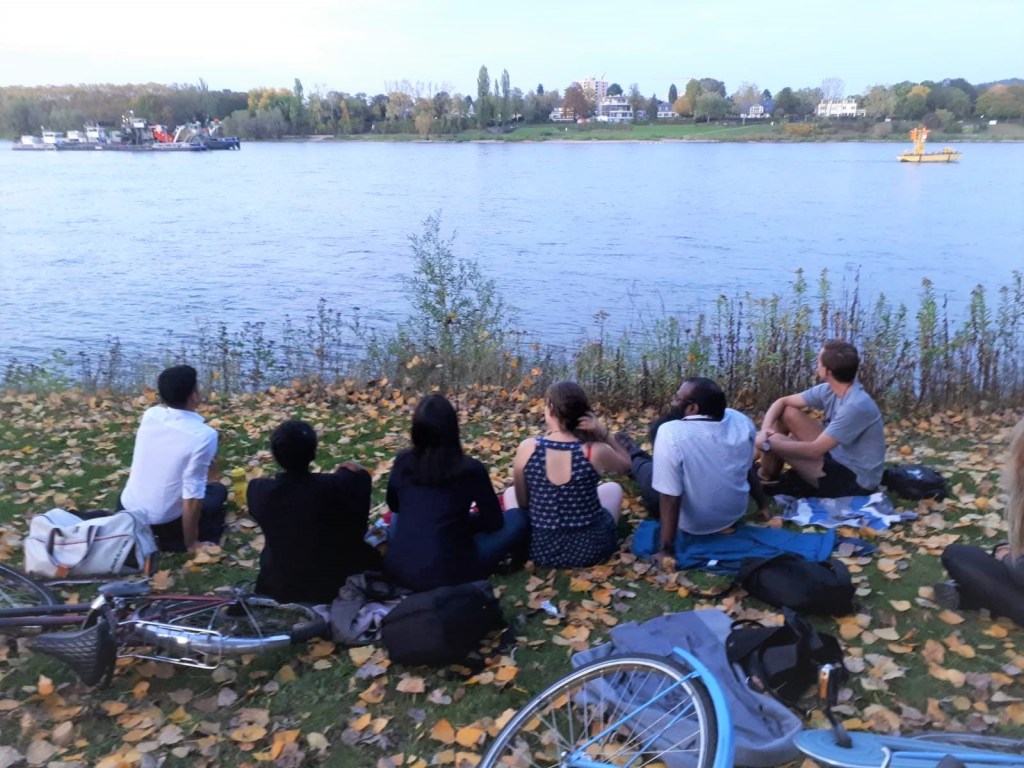
    On the last day of my internship I walked out of the UN premises some time in the afternoon. It was a sad day, because most people were away for the holidays. I walked slowly to where my bike was parked, which happened to not be at my usual spot. I stood there thinking of going for one last cycle by the Rhine behind the UN and Deutsche Welle buildings, but I shrugged it off because I decided that cycles by the Rhine belonged to a beautiful memory of Fall when I went to see Joker with my friends and we enjoyed one of the last sunny days of 2019 by the river.

    By the Rhine, early October 2019

    I would like to keep thinking that in Bonn the sun always shines on golden leaves and bright green grass, even when it’s dark and cold in the Winter, and that all my Bonn friends are seated somewhere by the Rhine, drinking wine and talking while I’m still trying to find my way there through Google Maps, because I’m always late to these things.

    With friends by the Rhine near UN Campus, Bonn, early October 2019

    “Anyway, home is where you feel at home. I’m still looking.”

    Holly Golightly, Breakfast at Tiffany’s (Truman Capote)