Author: Nibwene

  • Bridgerton: I have opinions

    Bridgerton: I have opinions

    Spoilers warning!

    The Gossip Girl reboot no one asked for is finally here! I wasn’t quite sure I wanted to watch it, I resisted it when it came out, but it turns out I’m a basic bitch who will watch anything on Netflix, the McDonald’s of streaming services, as long as it’s trending on Twitter. I can’t lie, I am happy that I did because Bridgerton has given me something to write about, of course in addition to the pleasure of seeing Lady Whistledown in action. For those who don’t care enough to watch the show, Lady Whistledown is a 19th-century version of Gossip Girl voiced by Julie Andrews (perhaps you should care about that); she’s the show’s one and only source into the scandalous lives of London’s elite.

    Like Lady Whistledown, I have things to say even though no one asked. I do enjoy overanalyzing things so this is my moment, I guess (also, I’m unemployed meaning I have a lot of free time).

    Maybe I should start with some comments on the casting. I personally love that the cast isn’t entirely white, even though the story is about the lives of London’s elite in the 1810s-1820s, but where are the black women? Where are the black women, Netflix? So many YouTubers and writers have brought this up and yet the same thing happens again and again.

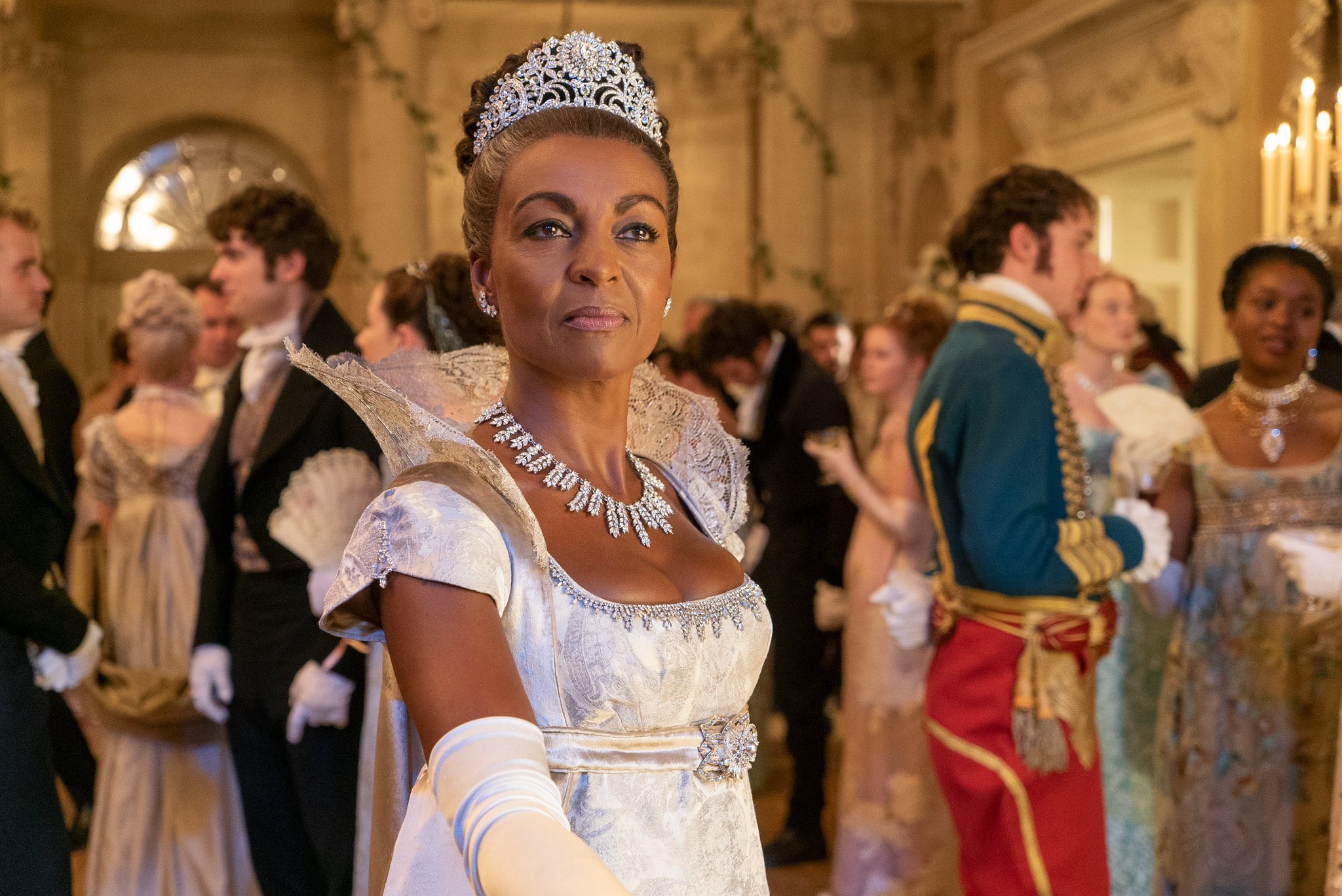
    Lady Danbury played by Adjoah Andoh

    The entire show has only one woman on the darker end of the spectrum, Lady Danbury (who we stan, by the way). Even though the character of Lady Danbury is absolutely fantastic, she plays into the Black Lady Therapist trope. We’re not told anything about Lady Danbury, but we’re shown numerous times that she exists to make Simon’s life easier. We don’t know anything about her life, her family or how she got her title. Everything she does in this season is directly connected to Simon; meetings with Mrs. Bridgerton to scheme so that Simon and Daphne could end up together, giving Simon words of advice, kicking everyone out of the ball so that Simon and Daphne can spend the night, the list goes on. On top of all that, even the other black women (Madam Delacroix and Marina) have somewhat unfavorable/undesirable characters in comparison to everyone else. Marina’s portrayal as the angry black girl reminds me of Vanessa from the original Gossip Girl. Take that as you will.

    I would love to see more darker-skinned black women in the main cast in the following seasons because the colorism is not cute, Netflix. There’s an obvious pattern in Netflix-backed shows, and I think Bridgerton could be an opportunity to begin to end it. It would be refreshing to see a young darker-skinned black woman (who isn’t a prostitute) being courted, getting expensive dresses at Madam Delacroix’s shop, and having enough character depth (that doesn’t play into stereotypes) to make her memorable.

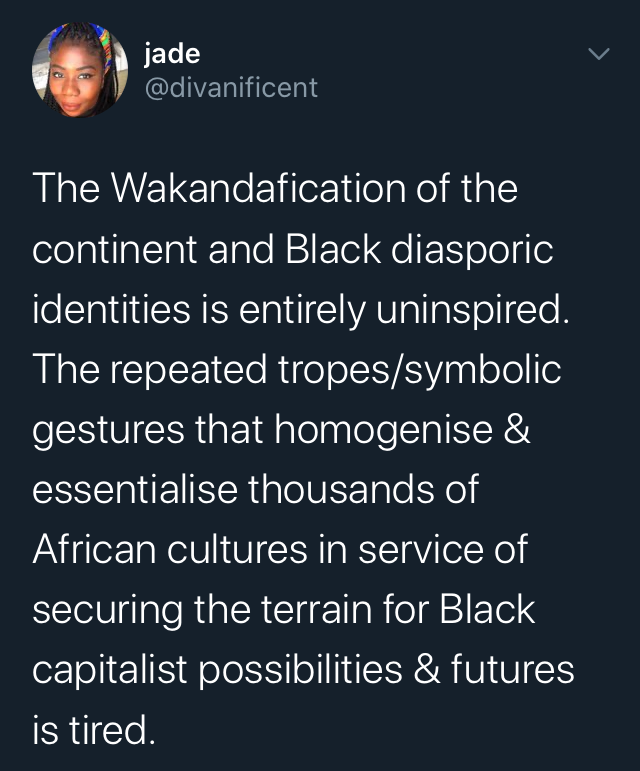
    Now let’s talk about Simon. This is the tweet that pushed me to watch the show.

    He really needs therapy, and not from Lady Danbury: I’m sure she has a life of her own to live. This man clearly has issues, which we all understand given the nature of his relationship (or lack of) with his father. The way he chooses to fix things by making a ridiculous revenge vow at his father’s deathbed and acting like he doesn’t care about the woman he loves was sad to watch. He is Chuck Bass himself; toxic just like his marriage to Daphne. Alexa play “Ruin My Life” by Zara Larsson. One thing I liked about their marriage was their honeymoon, which could easily count as a Netflix special for Ariana Grande’s positions album. They’re quite something. I’m sure some kid somewhere is working on a video compilation for a fake 34+35 or nasty music video to put on YouTube. I cannot wait to see it.

    Daphne’s opposite is Sienna. Born without a title meaning she has to do all kinds of things to make ends meet; be both an opera singer and a sex worker. She even ends things with the man she loves because she respects herself enough not to be treated like anything short of a queen. Sienna and Anthony show us that if you’re going to love someone as you claim then you should love them however they are, and not try to change them so that they’re more presentable for you.

    I also just want to say that I love Eloise and I wish I had a voice like hers. I’ve read the tweets calling her annoying and “a one-note character”. They have some truth in them. In a society like the one in Bridgerton, a young feminist character like her is very realistic and relevant. And, as we all know, a lot of the issues women had back then are still faced by hundreds of millions of women today, so we need characters like her to show us how much progress we’ve actually made since the 1800s, or not.

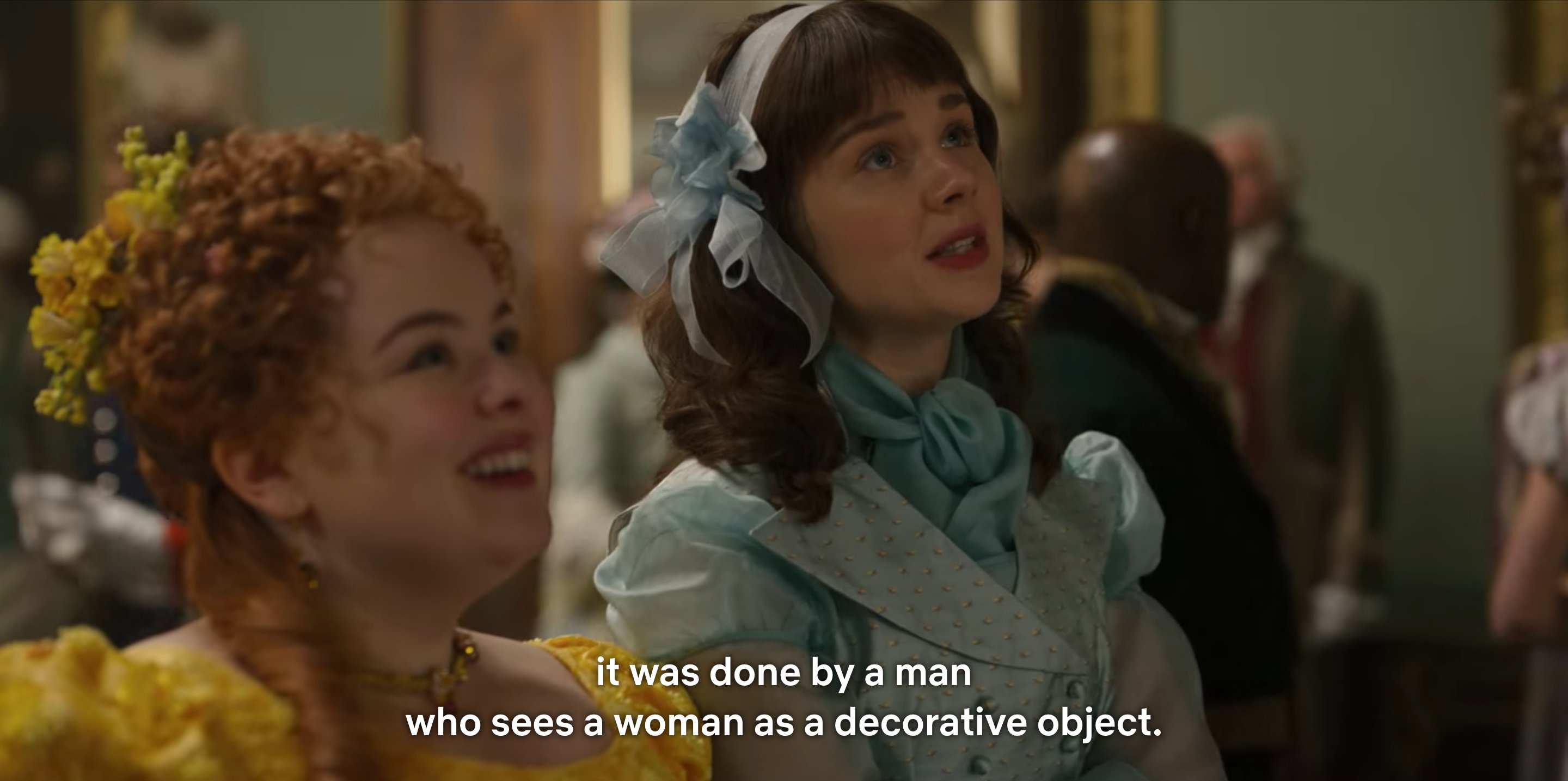
    Penelope (left) and Eloise (right)

    Lastly, I’m not sure if I should be promoting this show. I’m not getting paid to do that. But, if it means you’ll stay home then please go watch it and anything else you find interesting on Netflix or wherever.

  • Christmas movies, capitalism and colonialism. Sorry.

    I’m here to shit on Christmas movies because a) I don’t like the idea of Christmas b) I don’t remember the last time I had enough “Christmas Spirit” to keep me joyful about the holidays for a whole month: I’ve spent the last 3 Christmases alone so, in a way, I don’t really care what Christmas magic has to offer. c) I have too way much time, and I spend some of that time thinking about some very serious issues that affect modern society: Why are Christmas movies a thing? Will Meghan Markle play herself in The Crown? Will the colonization and continued oppression of indigenous peoples ever end??

    This hasn’t been the best year (it is actually the worst year I have ever had) so I needed to focus my energy on something. Something that wouldn’t let me down. I was hoping that Christmas movies would make me angry and want to scream, and they did exactly that. I watched a bunch, my calculations tell me about 15-20, which was way more than my poor brain could handle. Here are my thoughts. Read till the end for an incomprehensive list of movies you should watch on Netflix this holiday season.

    I noticed very early on that most Christmas movies are about women seeking or finding love around Christmas time. This triggered me. Most of these women have successful corporate jobs or live in big cities, but we’re made to believe that their lives are incomplete and unhappy until they find love-no matter what remote town they end up in because of love. The parents of these women would push their daughters to achieve the best, e.g. a medical fellowship in Boston (Christmas Under Wraps), or the women would want the best for themselves in the art world, for example, (Christmas Wonderland), but a man would come along and make them want to settle in the middle of nowhere Alaska where the richest man is actually Santa Claus and his factory workers are the slaves or elves, whatever you decide to call them (by the way this is an actual movie plot). I applaud one movie for putting more focus on the guy’s story (Christmas Made to Order). Do you see what’s going on here? The capitalist machine is preparing us for Valentine’s Day where they’ll sell us cheaply made cards, flowers, and other useless things that for some reason are supposed to mean “love” just because they’re red. Love is beautiful, but it doesn’t help to keep portraying falling in love as the only meaningful thing to happen during the holidays. What about the women who find happiness and comfort in being alone? I would love to see this in this movies and not women made to give up their well-paying big city jobs so that they can move to the rural town they grew up because they want to be with their high school ex.

    I have also come to the conclusion that there is a Netflix Christmas Movie Cinematic Universe: the NCMCU (this is not innovative, I know). The first clue was Sharl the Baker. He appears as Sharl the Baker in both Christmas Wedding Planner and Christmas With a View. Then, if you consider Vanessa Hudgens’ The Princess Switch movies, especially the second, it is very likely that there is a fourth lookalike, i.e. Brooke Winters from The Knight Before Christmas. This makes more sense if you consider that both stories are about European monarchs falling for slightly above average American girls.

    And what’s a cinematic universe without some white saviors? Let’s talk about Operation Christmas Drop. The streets (Twitter) are saying that Guam has been misrepresented in the movie. The protagonist is a black woman who works for a US Congresswoman. In one scene she is so moved by the poverty of the kids she meets in one of the islands, and then she just hands out whatever is in her purse to the kids: pens, HER USED HAIRBRUSH, and the handbag itself with whatever else that was in it. Seriously? What the children of Guam really need is the end of US military occupation so they can grow up in an independent country where they have full control over what happens within their borders. Using a black woman doesn’t take away the white savior trope. A black American woman who works in the US government is still an element of the American imperialistic framework, which works because of the white savior complex and other things. Basically, anyone from a Western country trying to “save” indigenous communities is a white savior, because being from the West is still very much associated with whiteness. Operation Christmas Drop is a glorification of Western occupation of indigenous land, and modern colonialism, which is bad! Was this movie supposed to be a cute story about the US military (of all things) because it’s about Christmas?? I hope it flops.

    Enough of my ranting. Here’s what you should consider watching in the next two weeks. These are some of the movies that managed to get some Christmas spirit out of me-just enough to keep a smile on my face for a few minutes. Enjoy!

    • Klaus (a must watch!)
    • Die Hard (it is a Christmas movie, don’t try to argue)
    • Jingle Jangle: A Christmas Journey
    • Dolly Parton’s Christmas on the Square
    • How The Grinch Stole Christmas
    • Elf
    • Christmas Chronicles

    And if you still want to watch trashy movies then these are some of the movies worth your time. They have bizarre, but somewhat fun plotlines.

    • The Princess Switch
    • Christmas Wedding Planner
    • Love Actually

    Merry Christmas, or whatever.

  • Rethinking John Green

    I spend my days in sketchy corners of Twitter and YouTube where I get triggered to write about topics that probably no one cares about. But it’s fun so here we are.

    “To weird”, he said.

    “To weird,” we clinked cans and sipped

    Turtles All the Way Down, John Green

    I read a tweet about a year ago (now deleted) about how similar John Green novels are. I felt so embarrassed because when I was 17 John Green was the Peter Van Houten to my Hazel Grace Lancaster, pre-Amsterdam trip. I once borrowed four, yes 4, John Green novels from my high school library. Paper Towns, An Abundance of Katherines, Will Grayson, Will Grayson, and The Fault In Our Stars. I read all except Will Grayson, Will Grayson because I couldn’t keep up with the weird two-author format. Years later I read Looking for Alaska and Turtles All The Way Down. It’s been nearly two years since I read the most recent one, Turtles All the Way Down and so, I’ve had plenty of time to think about John Green’s works.

    It’s true, they are all very similar. I read the same book multiple times and the only thing I can say to defend myself is that John Green’s books are very, very quotable and I love quotes.

    So let me give a summary of the books, without giving away too much, just for context.

    Looking for Alaska follows a teenage boy (Miles) who seeks a profound meaning/experience in his life. He falls for a girl, Alaska and he tries to understand her.

    Paper Towns follows a teenage boy (Quentin) who is fascinated by a girl, Margo Roth Spiegelman, who is considered to be this cool girl that everyone wants to be or be friends with.

    An Abundance of Katherines follows a teenage boy (Colin) trying to be a genius by attempting to discover something. So he comes up with a formula that predicts how long his relationships with girls named Katherine lasts (he’s dated like 20 of them…).

    The Fault In Our Stars is the most known John Green book. It’s about a teenage girl with cancer who falls for a teenage boy who also had/has cancer and is dying. They bond over their love for a novel called An Imperial Affliction by Peter Van Houten.

    Turtles All the Way Down. For a while, maybe two years, this was my favorite book. In this book, John Green writes about Aza Holmes, a teenager with obsessive-compulsive disorder (OCD).

    Similar plotlines

    When reading Looking for Alaska and Paper Towns I got the impression that life is about chasing something great, unusual, and perhaps even unreachable. Both Miles and Quentin are trying to find a girl (Alaska and Margo). John Green starts both stories with a Tumblresque quote signaling the story’s direction. The “signal quote” is placed somewhere in the first few pages.

    “The way I figure it, everyone gets a miracle…But my miracle was different. My miracle was this: out of all the subdivisions in all of Florida, Indeed up living next door to Margo Roth Spiegelman.” (Quentin, Paper Towns)

    “So this guy, François Rabelais. He was this poet. And his last words were, ‘I go to seek a Great Perhaps.’ That’s why I’m going. So I don’t have to wait until I die to start seeking a Great Perhaps.” (Miles/Pudge, Looking for Alaska)

    It comes to no surprise that both stories are centered around a girl. The thing about Alaska and Margo is that they are very, very similar. Popularity, beauty and quirky habits are characters that both have. On the other hand, Miles and Quentin are generally irrelevant in their schools. They’re nobodys who want to save themselves from their situations and think that this girl(s) is the Great Perhaps, the Miracle, the answer, etc.

    John Green writes things like, “If people were rain, I was drizzle and she was a hurricane.” (Miles/Pudge, Looking for Alaska). Drizzle wishes it was always followed by a hurricane so that it could mean something in the world precipitation. Instead, it’s just drizzle. Even the Weather app doesn’t pick it up sometimes. It wants to be seen and to mean something and so it seeks its hurricane; its great perhaps. Do you see the problem with this?

    It ties into the whole discussion about Manic Pixie Dream Girls in literature, mostly film and TV. Basically, a MPDG is a free-spirited character (female) with a peculiar background or habits that draw the (usually male) protagonist towards them. The male protagonist is always in love with the MPDG and she exists to teach the protagonist some grand lesson. Alaska is there to show Miles that life shouldn’t be taken so seriously. She says cringey things like “Y’all smoke to enjoy it. I smoke to die.” Look, I get it. Teenagers have mental illnesses that push them to make questionable life choices. We’ve all been there. But this line…really, John? Oh and just before that, he writes, “She looked at me and smiled widely, and such a wide smile on her narrow face might have looked goofy were it not for the unimpeachably elegant green in her eyes. She smiled with all the delight of a kid on Christmas morning…” Really? The problem here is that it’s not just one or two sentences. It’s the whole book. You find parts like these describing the MPDG (Alaska or Margo). In another part he writes, “…she (Alaska) was beautiful. In the dark beside me, she smelled of sweat and sunshine and vanilla.” Yes, sweat. It’s almost as if these protagonists have literally nothing going on for themselves and that is why their stories center around these MPDGs.

    Let’s look at Paper Towns and how Quentin actually spent days searching for clues about where Margo is and then he goes on a road trip to find Margo who had ran away from home just before the end of high school. The same Margo who he barely hung out with. She had her own social life with friends and a boyfriend, until he cheated on her, and then she suddenly shows up at Quentin’s window asking for help in her immature middle-of-the-night revenge scheme as if the entire 9 years where they barely talked hadn’t happened. Regardless, Quentin felt that he needed to do what he did. The entire book is him trying to figure out where she went and then actually dragging his friends on a long road trip from Florida to New York. But what does Quentin have outside of his Margo obsession? Nothing. She’s his “miracle” and the strangest thing is that we barely learn anything about her in the book. She’s only there to reveal to him that paper towns like theirs only look good from the outside. “…everything’s uglier up close”. I guess she’s there to make sense of the book’s title. Even though the book is mostly about her and paper towns get mentioned very few times.

    Characters of color

    This is a touchy topic. Personally I don’t care if a book lacks diversity among its characters, especially if it’s set in what can be assumed to be a predominantly white society. I do, however, think it’s ridiculous to include non-white characters for shallow comedic plotlines. This is a common feature in John Green’s books.

    In An Abundance of Katherines you have Hassan who is of Arab origin, in Paper Towns Marcus is black and Daisy Ramirez is obviously latina, in Turtles All the Way Down.

    Hassan serves as Colin’s sidekick in An Abundance of Katherines, he’s written in a way that doesn’t make you care much about him even though he’s always there. I can’t even remember anything significant about him other than something to do with baguettes. In Paper Towns, Quentin mistakenly buys a confederate flag T-shirt for Marcus while on their road trip to New York, and it’s all resolved as a small funny mistake. Also it is mentioned somewhere (or maybe multiple places) in the book that Marcus’ parents own a large collection of black Santas. I know: what? In Turtles All the Way Down, Daisy says things like, “I have the soul of a private jet owner, and the life of a public transportation rider”, and in reference to being asked why she used past tense in a conversation about Star Wars, she says, “Because all of this happened a long time ago in a galaxy far, far away, Holmesy. You always use the past tense when talking about Star Wars. Duh.” I love Star Wars, but this is a bit cringey.

    After reading Turtles All the Way Down I realized that Aza is just a female version of Colin from An Abundance of Katherines. She and him are seemingly calm and sensible in comparison to their best friends, i.e. Daisy and Hassan, who tend to be very out there with this and that. Like Hassan, Daisy comes off as a rebel who is there to bend societal codes of conduct in order to get what she wants. Hassan is self-proclaimed slacker, whereas Daisy convinces Aza to participate in her plan to win a reward for information about the fugitive billionaire, Mr. Picket, and she uses Aza’s connection to Mr. Picket’s son, Davis, to do that.

    Again, pointless plotlines that make them come off as ridiculous characters in comparison to the protagonists, and, as a matter of fact, every other character.

    The writing

    If you’re a regular here (thanks by the way), you might’ve noticed that I tend to use a lot of John Green quotes in my writing. There’s here, here, here and here.

    I love John Green’s quotes, I won’t lie. However, it comes off as if his books are repetitive pop albums where every song was carefully crafted to be on the Billboard Hot 100. I don’t read much, but I’ve read enough to see that John Green’s novels have an unusually high number of quotable lines. I mean, I even wrote this. It’s almost like he knows there’s a niche for his words somewhere on the internet: Tumblr. There’s an attempt to be profound and interesting, but it has been done so many times throughout his writing career that it has gotten old and boring.

    Quotes like “I go to seek a great perhaps” and “everyone gets a miracle” make it seem like there’s something more to life than what we have right now. I don’t know about others, but when I read most of these books between the ages 17 and 20, I found myself wishing I could escape to an unknown place or that I could find someone to help me escape the little labyrinth that I felt I was living in. That stopped me from living in the moment and I spent my days in my room dreaming of what couldn’t be. Frankly, I’m tired of running away from places and as I figured last year, the only miracle I get in life is being able to do what I can do; the daily mundane tasks and not-so-mundane ones like writing that allow me to grow. Really, life is that simple; a complete opposite of what a John Green quote/book will try to tell you.

    I think John Green is smart in the way he uses words. I love that. He makes me feel things when I read his works, depending on the situation I’m in. I remember saying “pain demands to be felt” to myself over and over, back in my teenage depression days. That quote still gets me through things. But as a novelist, I know now that he is basic. There isn’t much to think about when you read most of his books. The plots tend to be shallow, especially considering how some of these stories focus on the protagonist’s female love interests who we don’t learn anything significant about. Despite the quotes and the very vivid descriptions of physical beauty, Margo and Alaska are still two very mysterious and unknown people.

    The Fault In Our Stars was John Green’s best work. It has its flaws (kissing in the Anne Frank House???), but is different from the rest. TFIOS is just two people who are uniquely compatible and they fall in love despite both of their lives literally hanging by a thread. No one is seeking the other to find themselves. Each is a whole person wanting to love someone else. Very matured when compared to the likes of Colin, Miles and Quentin whose entire personalities are based on finding/understanding girls who each think is his better half. The most impressive thing in TFIOS, to me, is Augustus’ character development where he later understands that he is not a nobody after all. Someone cares about him and even though it isn’t a hurricane of people building monuments and naming streets after him, the terminally ill drizzle that admires him is still precipitation and that’s all that matters.
  • Wakandafication

    As usual, something happens on the internet and someone tweets about it and I say to myself, ‘that would make a great blog post topic’.

    I believe this is related to something Beyonce did or will be doing soon with Disney, but I’m not really a fan or a follower and I do not know anything significant about her work, so I will not comment on that. I’m here to have fun with different (but maybe similar?) arguments.

    If you’re not familiar with the term ‘Wakanda’, allow me to direct you to Marvel’s Black Panther film from 2018. A majority of the film is set in the fictional East African kingdom of Wakanda. Wakanda is exactly what the “Africa isn’t what you think it is” crew try to portray when they tell you that Africa isn’t what you think it is. It’s an African country that is still in touch with its roots because unlike others, it was never colonized. Wakanda still has poweful monarchies with political power and best of all, they figured out a way to use their most precious resource, the metal Vibranium, for their benefit. Wakanda’s technological capability is top in the Marvel universe. It is indeed a pan-Africanist’s fantasy, but that’s all that it is: a fantasy.

    Black Panther came out, many of us (people of African descent) hyped it up, it got an Oscar nomination (which it did not deserve, in MY opinion) and a few of its elements, like the “Wakanda Forever” salute made its way into mainstream media through hashtags, dances and memes. But something about the film lingered and I think it has stayed with us for too long.

    I remember going to Kigali, Rwanda in August 2018 and hearing someone call Rwanda ‘Rwakanda’. The nickname ‘Rwakanda’ was given to Rwanda because it’s said to be a hopeful African country. The cities are clean, things work (allegedly, I don’t know much to have a say on this) and several other progresses that have been made in the country, which are truly remarkable considering its recent history. The adoption of the nickname ‘Rwakanda’, even though not meant to be taken seriously, represents the wakandafication of real places in Africa by Africans (and others) in order to prove to the world that we are worthy of respect. It mirrors the common “we had kings and queens, we had great architecture…before European colonialism” narrative. This narrative tends to overromanticize pre-colonial Africa and glorify things which none of us actually know about very well. For instance, African societies didn’t just have monarchies, we still have them. They too are royal families with titles, but mostly without political power like many other royal families in European countries. The reason why we don’t hear about the African ones is the same reason why we want to prove that they once existed.

    Nigerian author Chinua Achebe wrote what I’m trying to say better:

    I do not see that it is necessary for any people to prove to another that they build cathedrals or pyramids before they can be entitled to peace and safety. Flowing from that, I do not believe that black people should invent a great fictitious past in order to justify their human existence and dignity today.

    Chinua Achebe. Also included in Africa Is a Country‘s post Beyoncé and the Heart of Darkness

    It’s almost as if we only want to be associated with Africa, or bring Africa to non-African spaces, if it is presented in a colonialism-never-happened-kinda-way. Wakandafication ignores the bad stuff, and reality. A good example is how conversations of ‘Rwakanda’ rarely acknowledge the undemocratic government in Rwanda. And for the democracy-doesn’t-work-in-Africa party, the ability to speak does not make you smart. It does, and it should.

    Wakandafication of Africa is the selection of desirable fictitious and real cultural elements, and their presentation in mainstream media as African and not as parts of different cultures in the continent. Wakandafication perpetuates the misconception of Africa as a country with a homogenuous culture and capitalizes on the pan-African idea that Africa is or should be one.

    Africa was never cool until Black Panther. Sometimes I think it still isn’t cool because most of what Africa is presented to be in mainstream media is just select unrelated elements of different African cultures that seem to give the idea that Africa is where it’s at, even though that is not true. (You may refer to a previous article I wrote on a similar topic). African countries, as they are, are not seen as desirable. Africa as a whole is, but only when given to the consumer in a way that makes them feel good about themselves; after wakandafication.

    Spirits, made-up rituals, lions, the savannah plains, rare minerals, etc. These are some of the things that make the cut during wakandafication. If we looked in a bit deeper we would know that spirits are not considered good in many parts of Africa because of their connection to witchcraft, which was never embraced in pre-colonial times, contrary to what some Twitter threads might try to tell you. In my tribe, for example, witches were explicitly bad because of their ability to cause harm to others, and that’s not on European colonialism. Some rituals like the one presented in Black Panther are just made-up and they are meant to be consumed as works of art and not to be brought into the real world as “our roots”. There were rituals before, but most of us don’t even know what they were, some of us don’t care to be honest, and it’s not anyone’s job to create new ones. Lions are being killed by poachers, read the news. The savannah plains are just the savannah plains and animals live there. Most are conservation spaces. Do they look good? Yes, but it’s very important to know the racist colonial history of these places. Rare minerals have become causes of human rights abuses, fraud and other crimes. I’m just trying to show what’s real.

    So, dear reader, things are not how we want them to be. I would love it if there was an African country as advanced as Wakanda. I respect the art that created Wakanda, but I will no longer participate in wakandafication and I hope you won’t either.

  • AfRiCa iSn’T wHaT yOu tHInK iT Is

    At 4:30 am (May 17) I was on Twitter, as usual, trying to delay sleep at all cost (yes, I have issues). I then have a random thought about Nas Daily, so I decide to check if he’s still doing his travel the world project. If you don’t know who Nas Daily is; his real name is Nusseir, he’s a vlogger who’s been traveling around the world for a while now and he makes daily 1-minute videos on his travels, last I checked. He might be doing something else now, but I really don’t care so I didn’t bother to look it up.

    There’s this video he did titled Be Careful in Africa! and basically, he documents some good things about the African cities he’s been to; Cape Town, Kigali, Nairobi, Casablanca, Lagos. He points out the good of Africa; nature, growing economies, there’s even a shot of a fancy car thrown in there and I don’t really get why. His whole point is that the Africa we see on international media isn’t accurate because there are clean roads in Kigali, so duh, Africa isn’t a sh*thole. I think I’ve always had a problem with these kinds of videos (not just his) because they oversimplify the issues that have and continue to challenge almost every country on the continent, since the end of colonialism.

    When talking about Cape Town he shows a clip of a white man next to a van and then an aerial shot of some residential area in the city while saying, “these houses go for $2 million USD each, this is one of the most expensive real estate on the continent!”. Now, this is problematic, even though it is a fact. To put this out there as something we Africans should be proud of and something that non-Africans should find nicely surprising is not a good look. South Africa is the most unequal country in the world. Not even a lifetime ago, the country was deeply segregated. The white minority controlled most of the wealth and their government implemented strict discrimination laws against the black natives and other non-white groups. I’m sure even Nusseir’s life overlaps with South African apartheid. Cape Town is what it is today, expensive and highly modernized in comparison to almost every other African city, because of apartheid. To single it out as “this is the Africa they don’t show you” is just weak. Unemployment rates in South Africa continue to be high, 20+ years after apartheid and many black South Africans continue to live in poverty. Why? Because of the system that enabled Cape Town to be what it is today while disenfranchising, exploiting and marginalizing the natives.

    This Nas Daily video represents everything I hate about Africa conversations in the western world. I’ve had several eye-roll moments when people would talk about how amazing Tanzania is and how living there is like experiencing a paradise. I even fell into this trap myself until one day in 2019 when I was at a dinner party and this man started talking to me about his travels to Tanzania while he lived in Kenya and all I could think of was #cantrelate. Most people who from African countries find their lives unbearable and unhappy because, “we live in paradise, but none of us have the time or the means to actually live here” (Deni, Guava Island).

    I absolutely hate every single “Tanzania” video on the internet that tries to be overly positive about the country, because they oversimplify the issues, just like the Nas Daily videos, and create a narrative that only works for specific demographics. To experience paradise in Tanzania you have to be rich, non-black and if you are black then you need to be a straight man. I’ll give an example from my own experience. Women in Tanzania get mistreated and a good number of us feel trapped and unhappy when we’re there yet you’ll see videos praise Tanzanian women for our decency. But we can’t even wear what we want. We have to be “decent” and cover our knees, etc. so that we don’t get beaten in the street (yes, it’s a thing) or get told that we’re trying to “tempt” men. We can’t express ourselves as intellectual and sexual beings without being called sluts and told that we should know our place in society, because God didn’t create us to equal men and so we can’t have the same freedoms – yes, I’ve been told this very many times by family members. To make a video that ignores the story behind is insulting and careless.

    This is just one example of the many issues in Africa that videos like Nas Daily’s fails to address and therefore, contributes to the same problem he’s trying to “fix” (my choice of word, not his). These videos are presented as content created to debunk myths like the world’s wrong perception of African countries as poor, diseased and with all kinds of evils, including the killings of people with albinism, among other things. Well, the truth is that these issues are present in Africa, very present, and I think it’s time we started being vocal about them on social media. Fearing for your life is a reality for many people, and poor living conditions are basically life in most African countries. I understand why we need to push back against the narrative that Africa is just huts and wildlife and not much going on. But we have to do it in a way that doesn’t downplay the issues that Africans face.

    Fact is, those three skyscrapers in Dar es Salaam won’t erase the unnecessary conservatism that enables inefficient authoritarian rule and misogyny to exist in Tanzanian society. They are there because the government allowed them to be. The same government that will rent them for public office space and restrict entry for women wearing pants and skirts that don’t cover our knees (I am not making this up). We keep saying, ‘Africa is changing’ to mean positive developments, but is it?