Category: movies

  • Christmas movies, capitalism and colonialism. Sorry.

    I’m here to shit on Christmas movies because a) I don’t like the idea of Christmas b) I don’t remember the last time I had enough “Christmas Spirit” to keep me joyful about the holidays for a whole month: I’ve spent the last 3 Christmases alone so, in a way, I don’t really care what Christmas magic has to offer. c) I have too way much time, and I spend some of that time thinking about some very serious issues that affect modern society: Why are Christmas movies a thing? Will Meghan Markle play herself in The Crown? Will the colonization and continued oppression of indigenous peoples ever end??

    This hasn’t been the best year (it is actually the worst year I have ever had) so I needed to focus my energy on something. Something that wouldn’t let me down. I was hoping that Christmas movies would make me angry and want to scream, and they did exactly that. I watched a bunch, my calculations tell me about 15-20, which was way more than my poor brain could handle. Here are my thoughts. Read till the end for an incomprehensive list of movies you should watch on Netflix this holiday season.

    I noticed very early on that most Christmas movies are about women seeking or finding love around Christmas time. This triggered me. Most of these women have successful corporate jobs or live in big cities, but we’re made to believe that their lives are incomplete and unhappy until they find love-no matter what remote town they end up in because of love. The parents of these women would push their daughters to achieve the best, e.g. a medical fellowship in Boston (Christmas Under Wraps), or the women would want the best for themselves in the art world, for example, (Christmas Wonderland), but a man would come along and make them want to settle in the middle of nowhere Alaska where the richest man is actually Santa Claus and his factory workers are the slaves or elves, whatever you decide to call them (by the way this is an actual movie plot). I applaud one movie for putting more focus on the guy’s story (Christmas Made to Order). Do you see what’s going on here? The capitalist machine is preparing us for Valentine’s Day where they’ll sell us cheaply made cards, flowers, and other useless things that for some reason are supposed to mean “love” just because they’re red. Love is beautiful, but it doesn’t help to keep portraying falling in love as the only meaningful thing to happen during the holidays. What about the women who find happiness and comfort in being alone? I would love to see this in this movies and not women made to give up their well-paying big city jobs so that they can move to the rural town they grew up because they want to be with their high school ex.

    I have also come to the conclusion that there is a Netflix Christmas Movie Cinematic Universe: the NCMCU (this is not innovative, I know). The first clue was Sharl the Baker. He appears as Sharl the Baker in both Christmas Wedding Planner and Christmas With a View. Then, if you consider Vanessa Hudgens’ The Princess Switch movies, especially the second, it is very likely that there is a fourth lookalike, i.e. Brooke Winters from The Knight Before Christmas. This makes more sense if you consider that both stories are about European monarchs falling for slightly above average American girls.

    And what’s a cinematic universe without some white saviors? Let’s talk about Operation Christmas Drop. The streets (Twitter) are saying that Guam has been misrepresented in the movie. The protagonist is a black woman who works for a US Congresswoman. In one scene she is so moved by the poverty of the kids she meets in one of the islands, and then she just hands out whatever is in her purse to the kids: pens, HER USED HAIRBRUSH, and the handbag itself with whatever else that was in it. Seriously? What the children of Guam really need is the end of US military occupation so they can grow up in an independent country where they have full control over what happens within their borders. Using a black woman doesn’t take away the white savior trope. A black American woman who works in the US government is still an element of the American imperialistic framework, which works because of the white savior complex and other things. Basically, anyone from a Western country trying to “save” indigenous communities is a white savior, because being from the West is still very much associated with whiteness. Operation Christmas Drop is a glorification of Western occupation of indigenous land, and modern colonialism, which is bad! Was this movie supposed to be a cute story about the US military (of all things) because it’s about Christmas?? I hope it flops.

    Enough of my ranting. Here’s what you should consider watching in the next two weeks. These are some of the movies that managed to get some Christmas spirit out of me-just enough to keep a smile on my face for a few minutes. Enjoy!

    • Klaus (a must watch!)
    • Die Hard (it is a Christmas movie, don’t try to argue)
    • Jingle Jangle: A Christmas Journey
    • Dolly Parton’s Christmas on the Square
    • How The Grinch Stole Christmas
    • Elf
    • Christmas Chronicles

    And if you still want to watch trashy movies then these are some of the movies worth your time. They have bizarre, but somewhat fun plotlines.

    • The Princess Switch
    • Christmas Wedding Planner
    • Love Actually

    Merry Christmas, or whatever.
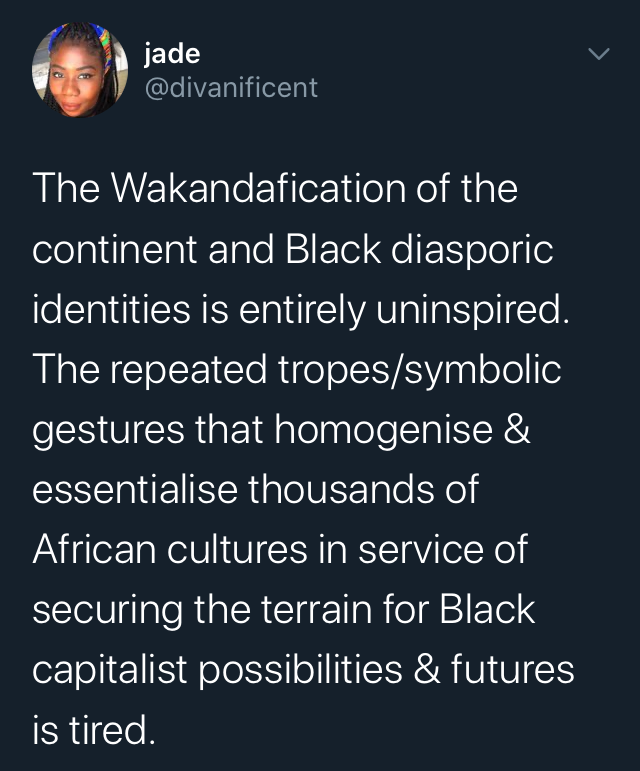
  • Wakandafication

    As usual, something happens on the internet and someone tweets about it and I say to myself, ‘that would make a great blog post topic’.

    I believe this is related to something Beyonce did or will be doing soon with Disney, but I’m not really a fan or a follower and I do not know anything significant about her work, so I will not comment on that. I’m here to have fun with different (but maybe similar?) arguments.

    If you’re not familiar with the term ‘Wakanda’, allow me to direct you to Marvel’s Black Panther film from 2018. A majority of the film is set in the fictional East African kingdom of Wakanda. Wakanda is exactly what the “Africa isn’t what you think it is” crew try to portray when they tell you that Africa isn’t what you think it is. It’s an African country that is still in touch with its roots because unlike others, it was never colonized. Wakanda still has poweful monarchies with political power and best of all, they figured out a way to use their most precious resource, the metal Vibranium, for their benefit. Wakanda’s technological capability is top in the Marvel universe. It is indeed a pan-Africanist’s fantasy, but that’s all that it is: a fantasy.

    Black Panther came out, many of us (people of African descent) hyped it up, it got an Oscar nomination (which it did not deserve, in MY opinion) and a few of its elements, like the “Wakanda Forever” salute made its way into mainstream media through hashtags, dances and memes. But something about the film lingered and I think it has stayed with us for too long.

    I remember going to Kigali, Rwanda in August 2018 and hearing someone call Rwanda ‘Rwakanda’. The nickname ‘Rwakanda’ was given to Rwanda because it’s said to be a hopeful African country. The cities are clean, things work (allegedly, I don’t know much to have a say on this) and several other progresses that have been made in the country, which are truly remarkable considering its recent history. The adoption of the nickname ‘Rwakanda’, even though not meant to be taken seriously, represents the wakandafication of real places in Africa by Africans (and others) in order to prove to the world that we are worthy of respect. It mirrors the common “we had kings and queens, we had great architecture…before European colonialism” narrative. This narrative tends to overromanticize pre-colonial Africa and glorify things which none of us actually know about very well. For instance, African societies didn’t just have monarchies, we still have them. They too are royal families with titles, but mostly without political power like many other royal families in European countries. The reason why we don’t hear about the African ones is the same reason why we want to prove that they once existed.

    Nigerian author Chinua Achebe wrote what I’m trying to say better:

    I do not see that it is necessary for any people to prove to another that they build cathedrals or pyramids before they can be entitled to peace and safety. Flowing from that, I do not believe that black people should invent a great fictitious past in order to justify their human existence and dignity today.

    Chinua Achebe. Also included in Africa Is a Country‘s post Beyoncé and the Heart of Darkness

    It’s almost as if we only want to be associated with Africa, or bring Africa to non-African spaces, if it is presented in a colonialism-never-happened-kinda-way. Wakandafication ignores the bad stuff, and reality. A good example is how conversations of ‘Rwakanda’ rarely acknowledge the undemocratic government in Rwanda. And for the democracy-doesn’t-work-in-Africa party, the ability to speak does not make you smart. It does, and it should.

    Wakandafication of Africa is the selection of desirable fictitious and real cultural elements, and their presentation in mainstream media as African and not as parts of different cultures in the continent. Wakandafication perpetuates the misconception of Africa as a country with a homogenuous culture and capitalizes on the pan-African idea that Africa is or should be one.

    Africa was never cool until Black Panther. Sometimes I think it still isn’t cool because most of what Africa is presented to be in mainstream media is just select unrelated elements of different African cultures that seem to give the idea that Africa is where it’s at, even though that is not true. (You may refer to a previous article I wrote on a similar topic). African countries, as they are, are not seen as desirable. Africa as a whole is, but only when given to the consumer in a way that makes them feel good about themselves; after wakandafication.

    Spirits, made-up rituals, lions, the savannah plains, rare minerals, etc. These are some of the things that make the cut during wakandafication. If we looked in a bit deeper we would know that spirits are not considered good in many parts of Africa because of their connection to witchcraft, which was never embraced in pre-colonial times, contrary to what some Twitter threads might try to tell you. In my tribe, for example, witches were explicitly bad because of their ability to cause harm to others, and that’s not on European colonialism. Some rituals like the one presented in Black Panther are just made-up and they are meant to be consumed as works of art and not to be brought into the real world as “our roots”. There were rituals before, but most of us don’t even know what they were, some of us don’t care to be honest, and it’s not anyone’s job to create new ones. Lions are being killed by poachers, read the news. The savannah plains are just the savannah plains and animals live there. Most are conservation spaces. Do they look good? Yes, but it’s very important to know the racist colonial history of these places. Rare minerals have become causes of human rights abuses, fraud and other crimes. I’m just trying to show what’s real.

    So, dear reader, things are not how we want them to be. I would love it if there was an African country as advanced as Wakanda. I respect the art that created Wakanda, but I will no longer participate in wakandafication and I hope you won’t either.