Last year I re-discovered my love for movies. Back in high school I went off the radar during one school break and I watched at least 2 movies per night for an entire month. This was in 2015: good times (only when I watched stuff: I was extremely depressed). Movies helped me escape the cruel realities of the world that my mind had created, and also some of the realities of the actual world. Life was dreadful and I wanted nothing more than to escape.
I fell in love with movies so much that I made handwritten lists. I think I still have them somewhere in one of the envelopes in my bottom drawer. Yes, I brought them with me to Germany. I made multiple lists of movies that I wanted to see in the coming years. I was inspired by this incredible list by TimeOut. I believe I’ve seen most of the movies in my lists, but I got lazy once I moved to Germany (p-wording is illegal here). I’ve watched great movies here and there in the last five years, but I haven’t been consistent. The one time I briefly re-discovered this hobby was during the first lockdown in Winter/Spring 2020. I even participated in this video by @LostInFilm. You can hear my voice from 1:51 over a clip from one of my all-time favorites, Before Sunrise.
In 2022, I made it my personal mission to get back into the movies game. I don’t think I’ve succeeded in the way I wanted to, but for the first time in a long time I felt strong emotions when watching a movie. It was the movie CODA, which also won Best Picture at the 2022 Oscars. I simply clicked on it out of curiosity and wasn’t really expecting to love it so much but wow. It’s a story of a teenage girl born into an all-deaf family but only she can hear, and sing quite well. It’s a story about the struggles that deaf people go through just to be able to do basic things like earn a living and on top of that it’s a beautiful story of family love. One moment in particular made me cry because I realized that even though our circumstances as human beings differ, we all share the ability to feel love for others. 5 stars from me. I strongly encourage you to watch this incredible film.
Bong Joon-ho during his acceptance speech for the Best Picture award at the 2020 Oscars.
CODA is just one example of many amazing movies across different genres. Movies are simply a beautiful form of art. I could watch them all day if I had the time. It brings me the same feeling I get when I read a really great book (read An Absolutely Remarkable Thing by Hank Green). I challenge you, dear reader, to watch more movies this year (check out my Letterboxd for some suggestions). Allow yourself to experience new things and possibly get lost on Wikipedia trying to figure out if the actor on your screen is the same one from that other movie from the 90s that you watched more than 7 years ago because they just look so similar. As you look for new realities to experience, also remember that great movies are not exclusive to Hollywood or other Western film industries. There are thousands of stories and beautiful worlds out there that you may never get to know if you’re unwilling to read subtitles. Where do you find these? Start here.
No matter who you are, you must be aware of this new film Don’t Worry Darling directed by Olivia Wilde. Unfortunately, it’s not because of the film itself but because of all the insane drama that has surrounded it since this year’s Venice Film Festival. Some words might ring a bell: Aperol, Miss Flo, #spitgate??
Harry Styles telling a reporter, “my favorite thing about the movie is that it feels like a movie. It feels like a real, like, you know, go to the theater film movie that you know you kind of the reason why you go to watch something on the big screen.”
Harry Styles was right. Don’t Worry Darling really felt like a movie. In fact, I realized it was a real film movie when I was at the cinema watching it. I have to admit that I liked it. I’ve been confused by the negative reviews. It may not be for everyone, but I think, it definitely deserved better. My theory is that some film critics were influenced by the drama that surrounded the film. Or is it misogyny as some claim?
One thing I absolutely loved about this film movie is that it made me angry. Once incel Harry Styles Jack was revealed, I became pissed. Incel Jack made me especially angry because he reminded me of some of the ridiculous men I used to argue with on Twitter. The kind of men who think they know best what a woman needs; any woman, even though these men have nothing going on for themselves. Jack is like that. Alice had what was hers, and he had nothing outside being an internet chatroom moderator. Somehow he felt like he knew what was best for her and that he had the authority to make life-altering decisions for her. We see this happen in many societies around the world where mostly men, and even other women, feel like they can make big decisions for women. We rarely see cases of boys and men being forced into marriage, yet the opposite is very prevalent. This is just like the film itself in which it was mostly the men that brought women into the Victory Project. Who knows who those men were to them: husbands? boyfriends? friends? stalkers? abusers? It’s simply too scary to think about, but unfortunately versions of the Victory Project are a reality to too many, and that makes me pissed.
One thing most of us can agree on is Florence Pugh’s acting. Give her an Oscar. Wow. I only ever saw her in Black Widow so I never paid attention, plus I was distracted while watching that. I’ll be watching her future projects from now on, because I am a fan of that talent. To think that Harry Styles was the best male actor to star alongside her is truly insane. Someone needs to investigate what went on with the casting. I am simply not convinced that he was the best one available. The audience laughed whenever he did his big acting with “emotions” and a raised voice. I am begging Harry Styles to focus on his music.
Don’t Worry Darling shows just how far some men are willing to go to control women. There are men who long to experience a reality where women are submissive, or actually forced to be. Sadly, we don’t even need a film movie to show us this since sexists are quite popular online.
Spoilers warning for the films Parasite and The White Tiger.
This year I had the time, finally, to watch 2019’s critically acclaimed film Parasite by Bong Joon-ho and the 2021 Netflix film The White Tiger by Ramin Bahrani. I told myself I’ll write something here on both and that was in January before my life took a somewhat chaotic and depressing turn. Skipping ahead to this calmer time, I am now ready to share my thoughts about both films.
Please note that this is more of an analysis of the issues that the films present, rather than a review. I never know what to say for reviews, nevertheless, I do like to indicate what I think about films on Letterboxd. I write “indicate” because I normally just rate the film using the star system, unless it was painfully bad, ahem, or a work of art that allowed me to experience heaven-like hallucinations and appreciate my existence. I use “hallucinations” because rats are terrifying and we need to talk about rat propaganda in film, but I‘m saving that topic for another time.
Anyway.
Context
Both Parasite and The White Tiger are set in Asian countries, South Korea and India respectively. This is important to keep in mind when analyzing them. I took it as these films are showing us the not-so-talked-about effects of economic growth in Asian countries that are often spoken of positively in the media and elsewhere. Last I heard, India is one of the fastest-growing economies in the world, and South Korea is one of the success stories in East Asia that went from Japanese occupation (1910-1945) and Korean War (1950-1953) to a highly developed society that is now influencing culture, specifically music (K-pop) and television (K-dramas), among other things, on a global scale like never seen before from a non-western country in the modern age.
As you can imagine, both India and South Korea are pretty big deals to economists. They are often talked about in a positive way. However, these countries’ economic growth comes with a cost to significant chunks of the population that reside in them and this is what both Parasite and The White Tiger show.
Disconnect of the rich
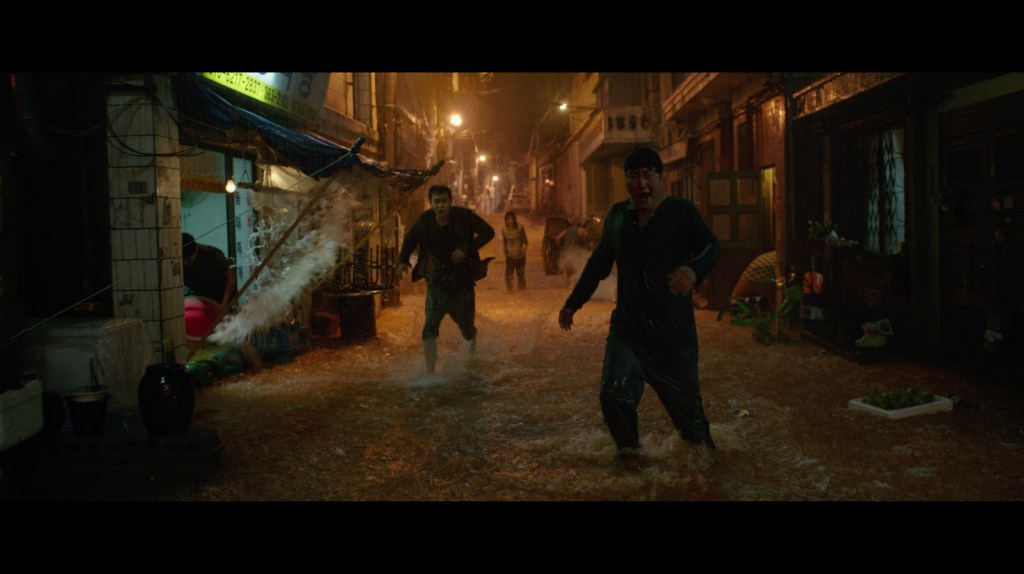
One of the similarities between the two films that struck me the most was Ashok (the rich guy in The White Tiger) telling Balram (the guy working as a servant) “I wish my life was as simple as yours”, and the lady in Parasite saying that the rain was a blessing meanwhile half of the city woke up in Bikini Bottom, including the driver (Ki-taek) that her husband underpays who was in the car with her during this scene.
Thinking of the rich being disconnected from reality reminds me how celebrities last year expressed how hard it was for them to spend time in their multi-million California mansions during the lockdowns. There were literally people dying, sick, homeless, broke because they lost their jobs, and all the above. Read the room???
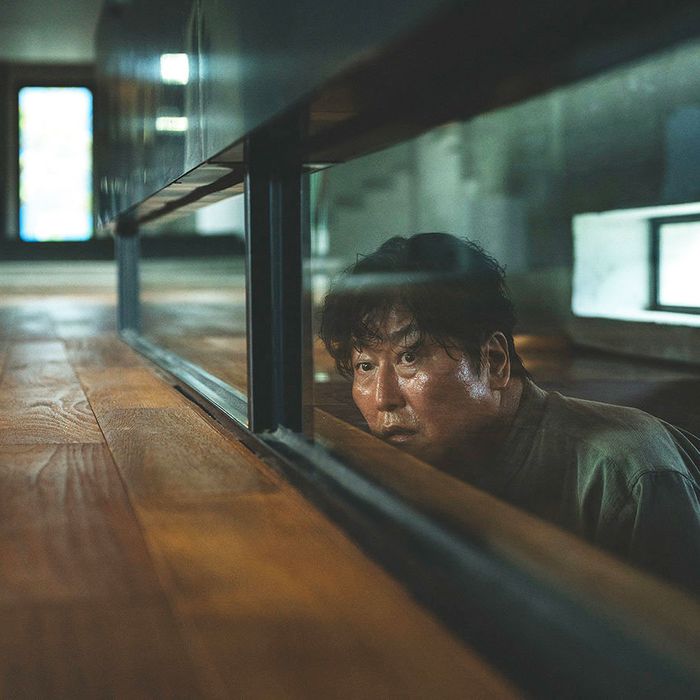
Ki-taek lives in a basement apartment with his family of four. Apparently, these are not so rare in Seoul, South Korea’s capital. Some of them can be fancy but if you live in the slums like he and his family did, chances are that it’s not.
What poverty looks like
Sad, trapped, depressed. Those are just some of the words I think of when I think of people who actually live like the Kim family in Parasite. It must be painful both mentally and physically to live in a developed society like South Korea while you are not at all developed in your life. The system keeps you in check and makes sure you never make it far. Get a job but you will be underpaid – just enough to keep an entire building over your head, literally, and even then you have to do extra work like folding pizza boxes just to keep going.
In The White Tiger, Balram got a job and still slept in the nastiest, unventilated place one could think of. The only way for him to get out was to cheat his way through by murdering someone and stealing. Some analyses of Parasite point out something similar – the Kim family had to lie, cheat and step on others just to get jobs. Tragically, the system punishes those who attempt to do better for themselves: Ki-jung, Ki-taek’s daughter who fits into the “wealthy” life so easily and eventually paid for it with her life.
I read a tweet (as I always do) that said that The White Tiger took a dark turn when Balram murdered Ashok and that this was not pleasant to watch. Disagree. The question is, are we this uncomfortable with seeing the reality of poverty? Why are we okay with the comedy part of The White Tiger where Balram is a laughingstock to us and to himself? He acts “funny” in the first half of the film and makes the viewer think ‘all is well because this poor guy looks happy with his life’, but we are uncomfortable the moment he shows a valid reaction to his situation. Yes, the reaction was dark, but it still happens even in real life. Some people are angry because they are poor and because they have no way of overcoming that. Balram could not do much to get ahead because his family was held hostage, with the threat of them being murdered following every action he took. Views such as these remind us that there is a deep class divide everywhere and it might never be repaired. Balram keeps referring to Ashok’s family as “my masters” even when he is already rich.
The White Tiger is just a small insight into the politics of Indian society as it continues to grow while simultaneously being the second-most populated country in the world. The unspoken message is, there are so many people in the country being exploited and left behind as the economy grows fast. While The White Tiger is simply fiction, it does not take much to uncover similar situations of exploitation in real-life India.
While The White Tiger shows us what the path to a developed capitalist society looks like. The India we see is about people shamelessly exploiting others, including children, and doing whatever is necessary to make it to the top, as how Ashok’s family and Balram did. Parasite shows us what this society looks like once it crosses the invisible finish line. It’s so glittery on the surface, but under this, there are people who are too poor to afford life on ground level.
I’m sure you’ve come across white savior films like The Help, Blood Diamond, Green Book, La la land and the latest being The Red Sea Diving Resort. This list is definitely not exhaustive.
First check out this Seth Meyers parody, just because:
The white savior complex is refers to the need/desire of a white person to help (save) “people of color” from problems that have been and are still caused by predominantly white societies, structures and practices (slavery, colonialism, imperialism).
White savior films are the scum of film-making. Not only do they undermine the struggles of people of color fighting against oppression, but they also continue to reinforce the idea that things can only work out if a white person is involved.
Meanwhile, in Africa, the toughest work clearly falls to the local guides who led the perilous Jewish exodus from Ethiopia to the Gedaref Refugee Camp. Raff composites all these heroes into a single character, Kabede Bimro (played by Michael Kenneth Williams, Omar of “The Wire”), the film’s only nonwhite ally of note.
The existence of these films is one of the reasons why white savior practices continue to thrive in the real world. Think of the horrifying case of Renee Bach. This is just one example of the white savior complex going into someone’s head to the point of her thinking she can actually bring change by playing doctor on Ugandan kids from a poor area suffering from all sorts of illnesses even though she has no medical degree. 105 kids died because of her irresponsible actions.
In his essay The White Savior Industrial Complex, Teju Cole writes, “if Americans want to care about Africa, maybe they should consider evaluating American foreign policy, which they already play a direct role in through elections, before they impose themselves on Africa itself.” I agree with this statement because the politics side of things is often overlooked. We might write hundreds of blog posts condemning white saviors, but the cause actually lies in politics. Western governments usually play roles in all kinds of conflicts and destruction in developing countries: Syria (currently), Cambodia (20th century), the colonization of Africa (Since the 15th century), the colonization of the Indian subcontinent (read on the Kashmir situation today). The result of all this chaos is that these places have become places that now need to be helped through charity organizations from the same countries whose governments contributed to the chaos through evil ideologies such as white supremacy that then led on to slavery, colonialism, etc. Even though lives get saved and significant numbers of people get the help they need, charity is pointless if the politics are all the same. Think about how we have had the United Nations for 74 years and organizations like UNHCR and UNICEF are literally everywhere, but today we have more than 25 million refugees and nearly 300,000 child soldiers worldwide.
I might have gone on a tangent there, but I hope you get my point: a good number of the world’s problems are a result of evil racist ideologies like white supremacy (colonialism and its effects, etc.) and the funny part is that films and some people try to tell us that the same ideologies are part of the solution. The white savior complex is cut from the same cloth as white supremacy. Thinking you’re capable of saving “people of color” through medical procedures even though you are as unqualified as they are is white supremacy.
Now back to the white savior films-they are simply a reflection of our world. One thing I feel that people with the white savior complex tend to ignore (in the context of African countries, for example) is that there are locals who can do the exact same thing a western volunteer does. The tough part is that locals are not seen as capable because of many things including the message carried by white savior films and the inferiority complex that many “people of color” still have to this day.
Also, a message to westerners wanting to spend a summer in some remote African village: there are literally people suffering in your own countries. Think about them before spending thousands of euros to travel across the world to do something that can easily be done by the local population. I’ve lived in Germany for 2 years now and I know western countries also have issues that need normal citizens to help, such as refugee integration.



 the writing nib