
This article is my Donda.
Spoilers warning for the films Parasite and The White Tiger.
This year I had the time, finally, to watch 2019’s critically acclaimed film Parasite by Bong Joon-ho and the 2021 Netflix film The White Tiger by Ramin Bahrani. I told myself I’ll write something here on both and that was in January before my life took a somewhat chaotic and depressing turn. Skipping ahead to this calmer time, I am now ready to share my thoughts about both films.
Please note that this is more of an analysis of the issues that the films present, rather than a review. I never know what to say for reviews, nevertheless, I do like to indicate what I think about films on Letterboxd. I write “indicate” because I normally just rate the film using the star system, unless it was painfully bad, ahem, or a work of art that allowed me to experience heaven-like hallucinations and appreciate my existence. I use “hallucinations” because rats are terrifying and we need to talk about rat propaganda in film, but I‘m saving that topic for another time.
Anyway.
Context
Both Parasite and The White Tiger are set in Asian countries, South Korea and India respectively. This is important to keep in mind when analyzing them. I took it as these films are showing us the not-so-talked-about effects of economic growth in Asian countries that are often spoken of positively in the media and elsewhere. Last I heard, India is one of the fastest-growing economies in the world, and South Korea is one of the success stories in East Asia that went from Japanese occupation (1910-1945) and Korean War (1950-1953) to a highly developed society that is now influencing culture, specifically music (K-pop) and television (K-dramas), among other things, on a global scale like never seen before from a non-western country in the modern age.
As you can imagine, both India and South Korea are pretty big deals to economists. They are often talked about in a positive way. However, these countries’ economic growth comes with a cost to significant chunks of the population that reside in them and this is what both Parasite and The White Tiger show.
Disconnect of the rich
One of the similarities between the two films that struck me the most was Ashok (the rich guy in The White Tiger) telling Balram (the guy working as a servant) “I wish my life was as simple as yours”, and the lady in Parasite saying that the rain was a blessing meanwhile half of the city woke up in Bikini Bottom, including the driver (Ki-taek) that her husband underpays who was in the car with her during this scene.
Thinking of the rich being disconnected from reality reminds me how celebrities last year expressed how hard it was for them to spend time in their multi-million California mansions during the lockdowns. There were literally people dying, sick, homeless, broke because they lost their jobs, and all the above. Read the room???
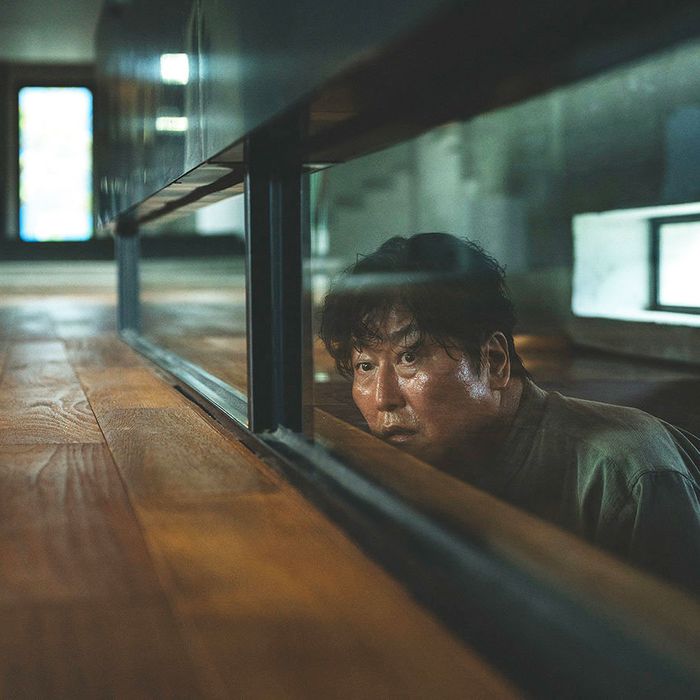
Ki-taek lives in a basement apartment with his family of four. Apparently, these are not so rare in Seoul, South Korea’s capital. Some of them can be fancy but if you live in the slums like he and his family did, chances are that it’s not.
What poverty looks like
Sad, trapped, depressed. Those are just some of the words I think of when I think of people who actually live like the Kim family in Parasite. It must be painful both mentally and physically to live in a developed society like South Korea while you are not at all developed in your life. The system keeps you in check and makes sure you never make it far. Get a job but you will be underpaid – just enough to keep an entire building over your head, literally, and even then you have to do extra work like folding pizza boxes just to keep going.
In The White Tiger, Balram got a job and still slept in the nastiest, unventilated place one could think of. The only way for him to get out was to cheat his way through by murdering someone and stealing. Some analyses of Parasite point out something similar – the Kim family had to lie, cheat and step on others just to get jobs. Tragically, the system punishes those who attempt to do better for themselves: Ki-jung, Ki-taek’s daughter who fits into the “wealthy” life so easily and eventually paid for it with her life.
I read a tweet (as I always do) that said that The White Tiger took a dark turn when Balram murdered Ashok and that this was not pleasant to watch. Disagree. The question is, are we this uncomfortable with seeing the reality of poverty? Why are we okay with the comedy part of The White Tiger where Balram is a laughingstock to us and to himself? He acts “funny” in the first half of the film and makes the viewer think ‘all is well because this poor guy looks happy with his life’, but we are uncomfortable the moment he shows a valid reaction to his situation. Yes, the reaction was dark, but it still happens even in real life. Some people are angry because they are poor and because they have no way of overcoming that. Balram could not do much to get ahead because his family was held hostage, with the threat of them being murdered following every action he took. Views such as these remind us that there is a deep class divide everywhere and it might never be repaired. Balram keeps referring to Ashok’s family as “my masters” even when he is already rich.
The White Tiger is just a small insight into the politics of Indian society as it continues to grow while simultaneously being the second-most populated country in the world. The unspoken message is, there are so many people in the country being exploited and left behind as the economy grows fast. While The White Tiger is simply fiction, it does not take much to uncover similar situations of exploitation in real-life India.
While The White Tiger shows us what the path to a developed capitalist society looks like. The India we see is about people shamelessly exploiting others, including children, and doing whatever is necessary to make it to the top, as how Ashok’s family and Balram did. Parasite shows us what this society looks like once it crosses the invisible finish line. It’s so glittery on the surface, but under this, there are people who are too poor to afford life on ground level.



 the writing nib