Author: Nibwene

  • did you girlboss too close to the sun?

    did you girlboss too close to the sun?

    Yes, I copied that title from Taylor Swift.

    Being somewhat of an academic “overachiever” with multiple prestigious scholarships in my past, I thought I could easily plan out my professional life the way I had previously planned my academic life. Go to this school, do this, study this, get internships and student jobs here in these specific things, boom – the career I want!

    The beginning of 2021 was tough but full of determination. I had big ideas and big dreams. I thought I could do anything; I was still existing in the high I got from spending 5 weeks in a small Austrian city in the Alps. When I say “the high” I mean… I thought I could do anything because I had spent the five weeks sleeping on an air mattress, spending an ungodly amount of time on TikTok and developing an eating disorder. So I wrote down what I wanted in G*ogle sheets and planned my career. In the next three years, I achieved the things I had wanted; I worked at the places I wanted to work at, learned alot and became more and more confident that I could become the version of me that I imagined in my head; one inspired by the many experienced women I worked with in my internships. I saw myself in my field of work (climate, energy, …).

    In the last year and a half, this image of future Nibwene has turned into ashes. The future I thought of is now, but, for more than a year now, one of my biggest achievements has been leaving my apartment regularly. I even had a whole mission this summer to go out every single day and vlog it, but I failed spectacularly because I lost my desire to do things after a job interview didn’t result in a job (my one interview since early September 2024; there were alot of expectations on my side). I have become what I imagine an ATS machine to be like: scanning for words and phrases like “unfortunately”, “regret”, “we wish you all the best” each time I open an email about a job I applied for. And all these rejection emails immediately go to trash and are deleted forever. I don’t want a reminder of my failures in my phone, which has become an escape in these trying times.

    So, I failed.

    Everything career-related has sucked. The project I was so excited to work in back in January, the one which I had hoped would open doors for me, turned out to be the most miserable experience of my life because of an individual. My payment was withheld for 5 months and when I started to ask questions about inconsistencies, I was yelled at, manipulated and dismissed. Long story short, I got my full pay eventually, but not without a fight. The experience has had an effect on me because now I have nightmares about it even as recent at last week.

    The other side of this is that I‘m not sure how to engage with the project’s report once it’s out there. I wrote about my country‘s energy transition landscape (in simple words). This kind of work typically involves being plugged into said country’s politics and possibly even directly engaging with policymakers. Now, we have an illegitimate government that “won” the recent “election” by 98%, is extremely corrupt from what I’ve seen and read, and murdered thousands of people in just a few days (and is currently trying to hide the evidence by disposing and withholding the bodies from their families). I’ve seen the images and videos of bodies on the streets of cities including my home of Dar es Salaam, on hospital floors and in places that had nothing to do with the protests. I can’t co-sign this evil in any way and that includes legitimizing the government by working on climate and energy policy in Tanzania.

    What now?

    This last year has made me realize how sucked in I was in these “intellectual” and “high-level” spaces where we try to save the world by fighting climate change, facilitating the energy transition and promoting “sustainable development”, whatever that means and many other targets. Most of these ambitious targets mean nothing because in these same spaces, nepotism and racial/ethnic discrimination in hiring is more important than the fairness that is often preached. I have my own anecdotes from my job search.

    What I’m realizing these days is that I don’t care anymore if I’m one of the people fighting climate change or working on energy policy or “development”. Worse, I don’t want to care whether my country is on the right path or not. Patriotism has its limits. At the end of the day, all I want is to afford this very expensive life, so I don’t know where that leaves me.

    In summary, yes, dear Reader, I did fly too close to the sun and burnt out.

  • Trad wife fantasies, Girlboss realities

    A trad wife is a married woman who makes it a point to live according to traditional gender norms. Essentially, a housewife, but with a religious fundamentalist attribute. Trad wives, including trad wives of colour, tend to be politically right wing. Another thing that makes them “trad” is that they are usually based in societies where they don’t really have to do all that, i.e., places where women’s rights are a thing in the law, among society and, to a large extent, properly enforced.

    I started thinking about trad wives two years ago when they were popping up on my Instagram reels. I blocked them everytime. I remember when I felt I had had enough after seeing one African American trad wife’s TikTok about picking cotton and her saying that it was part of her DNA. I wish this was fiction.

    In the last few months, i.e. in these tough recession times in Germany (yikes), I’ve been wondering what my life would be like if I hadn’t chosen to pursue an academic-adjacent career path. The rejections, the constant feeling of not being enough and non-stop grind has been exhausting and demoralizing. So, naturally, I have been questioning my career wants and wondering why I didn’t dance on TikTok during lockdown.

    One night a few months ago, I wrote a text in my notes app with the title of this post. The title was inspired by another article whose title used similar words and style. I thought it was a smart way to summarize opposing perspectives of the same situation. This text was my way of writing out my feelings at a time when I had doubts about my chosen path in life. I also thought of the “girlboss to trad wife pipeline” and whether my mind was going that route. (It is not lol).

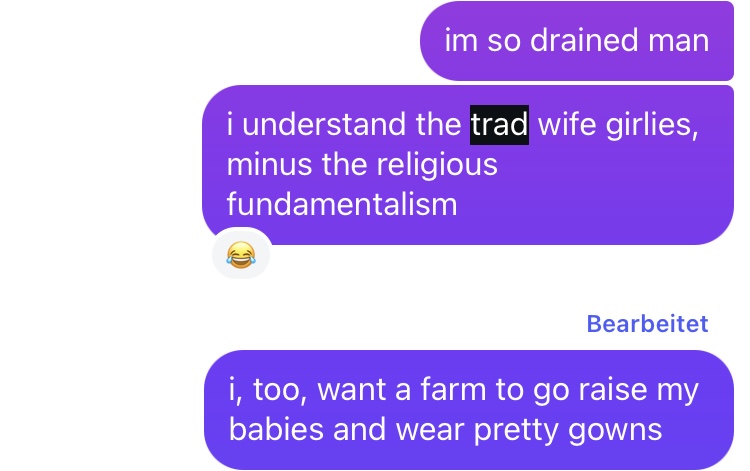
    Screenshot of me texting my friend in January

    The note went like this: In another universe, I had trad wife fantasies early in my adulthood. I pursued them and now live in a nice house, paid for by my husband, with my 3 kids. I am happy because my husband is loving and I have everything I need. In that world, I don’t dream of being a girlboss. I don’t have to network over hot beverages, or embarrass myself in people‘s inboxes. I‘m just me and that‘s enough to be a wife and a mother. I love to cook and play with my kids. In that world, I don’t spend 9 months of my life scrolling through LinkedIn and obsessively checking my emails everyday, waiting for something that’s not there, chasing after a career not meant for me. In another universe, I just know better. In this world, I am who I am: a girlboss at heart. I feed off the self-pat on my back that I’ve done a good job. When others say they love my work, I love that too, but it doesn’t make or break me. I’m a bad b*tch and I know it.

    A girlboss is “an ambitious and successful woman (especially a businesswoman or entrepreneur)”, according to Merriam-Webster. First, I need to say that, depending on who is using it, I think the term girlboss can be somewhat misogynistic. Calling a grown woman a “girl” can be disrespectful, but I don’t see an issue if we call ourselves that (maybe I’ll change my mind about this one day). I like this Merriam-Webster definition because it’s broad and doesn’t paint all ambitious women as mean girls who “gaslight” and “gatekeep”, unlike other interpretations of the term that I read elsewhere.

    Some might say that a trad wife can be a girlboss, but I don’t think this to be true. Yes, online trad wives are, in fact, working as content creators and chasing after fame and followers; they make money doing what they do. However, I think being a trad wife or labelling oneself as such is a limitation: I have to dress a certain way, have babies, serve my husband, act a certain way, etc. When it comes to a girlboss, these limitations do not exist. She does what she wants to get what she wants. A girlboss, in my view, is not characterized by how she fits into the patriarchy-defined attributes of a good woman.

    I’ve been in the girlboss mindset for my entire conscious life. I never ever seriously believed that I needed to live my life as a woman according to what the culture around me or my religion told me. I had concrete career plans in politics and policy that are not anything new, but ambitious enough to characterize me as a girlboss. And I pursued them as aggressively as I could. In these trying times, however, when I’m not able to picture the path ahead in the way that I envisioned, I feel lost. Who am I outside of my political grind?

    A friend wrote to me recently, “I really feel like the universe is pushing you towards something you can do for yourself…” I feel this too, I guess. I decided to get serious about writing (which is why I finally got a domain for this blog and started a Substack). While I love to write and have never not enjoyed it, even in school or university, I vented to my friend about how I wish a detour felt more like my choice rather than a semi-forced path because I had no other options. Maybe this feeling of lack of choice is why I’m the opposite of a trad wife: I hate doing things because I am made to by tradition, a husband, society, the economy, etc.

    That is why, dear reader, my trad wife fantasies are just that: fantasies. Regardless of the circumstances, I stay locked in on all my pursuits until I get what I want or die trying. This is my reality as a girlboss. Here, I’m reminded of a quote from the movie Dolemite Is My Name, “shoot for the moon and if you miss it cling on to a m*****f*cking star”.

  • this is me trying

    this is me trying

    The title and section titles are lyrics of the song this is me trying by Taylor Swift.

    I’ve been having a hard time adjusting

    I started my blog in high school because I was very depressed with bad thoughts, no where else to express what I felt and no one to turn to. The blog became a companion as I navigated my early 20s with even more depressive episodes in a foreign country. I stopped posting a lot because I found joy in the real world and refused to dwell in my writing because it tends to bring out unwanted emotions. I am back now, but calmer.

    I had the shiniest wheels, now they’re rusting

    Four years ago, Taylor Swift released the album ‚Folklore‘. It was the only thing I listened to that August. I was sharing an apartment just outside my old university in Bremen with a friend and essentially took over the smart TV so it only played the entire Folklore album‘s lyric videos from start to finish every morning to evening. I was very stressed back then. I had just graduated and was looking for the next opportunity. The previous month (July) had been tough, but August was starting to feel better. I did a written test which was the first part of the hiring process for an internship I wanted so badly. The waits in between the different hiring stages were excruciatingly long and at the time I wasn’t aware that this was normal. By the time September was around the corner, with no indication that I was going to the interview stage, I was in panic mode. So I booked a one-way 16-hour bus trip to from Bremen (Northern Germany) to Austria. My final destination, Leoben, a small city of less than 25,000 people somewhere in the Alps. I spent 5 weeks there.

    Most of the Austria subplot ends well; I got the internship of my dreams and made friends along the way. I had a great time and I felt like I finally had a foot in the energy sector‘s door. I was in. Things went uphill from there. After that, I worked at a research institute, a well-known international development organization, and another world renowned climate research institute. I thought my career in this sector was a sure thing, but it seems that the job market has other plans for me.

    So I got wasted like all my potential

    I look back at all these cool places I worked at and I can’t help but be grateful for the one person who hired me as an intern at the UNFCCC back in the summer of 2019 when all I had to my name was a high school diploma. That was my true „in“ and is what inspired me to want to work in some variation of climate action. I was just a 22-year old learning the ways of the world, drinking a little too much with my fellow interns after work, and having a life-changing experience. This is also the time one of this blog‘s readers, a stranger back then, reached out to me to discuss an article I wrote here. The stranger has become a very important part of my life *wink wink*.

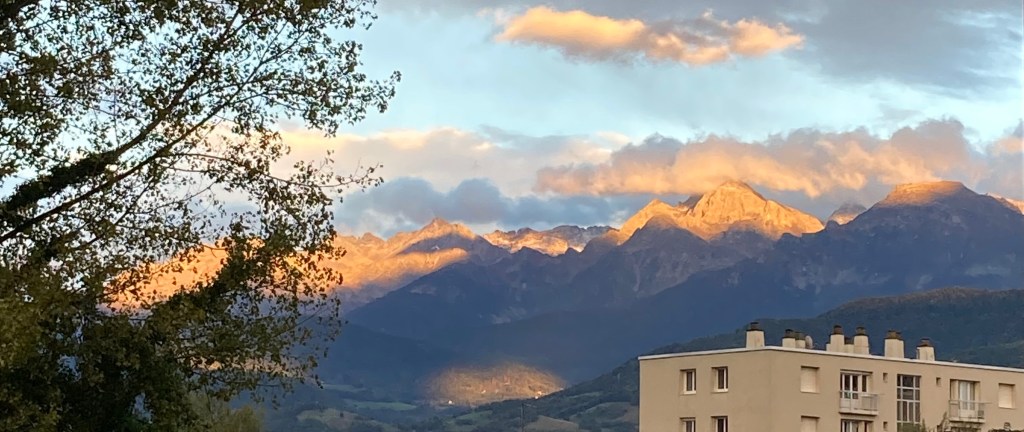
    This past June, I graduated from my master’s program. There are a lot of mixed feelings about my experience, but what I can write here is that I learned something, I did cool things and I met amazing people even though this took some time. Strangely, the first thing I think of about this time is dancing in a club to Amapiano with my uni friends. Now it’s been almost 5 months since my last class. I‘m exhausted because I was delusional and I thought I had it in me to get a job soon after graduation (or maybe even before). It’s October and here we are. Again, I‘m in a small city in the Alps; this time on the French side – making friends and doing who knows what. I‘m trying to figure out why someone hated me so much that they told me to apply for a job and then rejected me without interviewing me and then hired someone way less qualified for the position than me. (OK, so I found this out because I did some digging on LinkedIn, the cursed website). Also, I’m paying for LinkedIn Premium LOL. I got a sweet discount for two months when I signed up via desktop. It lets you “InMail” people you’re not connected to. Probably annoying for those on the receiving end of these mails, but whatever to make you feel like you’re making the effort.

    I just wanted you to know, that this is me trying

    Rejection is redirection, they say. So I hope this phase redirects me to somewhere where I never have to deal with such bullshit things again. And, maybe the real find was the realization that the Alps are a place of refuge for me.

  • Revisiting ‘Wakandafication’

    Revisiting ‘Wakandafication’

    In 2020, Jade Bentil, a Black feminist historian, used the term Wakandafication in a tweet during a wave of online discourse surrounding the trailer of the Disney+ film ‘Black Is King’ (I wrote about this here). She wrote, “The Wakandafication of the continent and Black diasporic identities is entirely uninspired. The repeated tropes/symbolic gestures that homogenize & essentialize thousands of African cultures in service of securing the terrain for Black capitalist possibilities & futures is tired.”

    Inspired by Jade Bentil’s tweet, I came to my own explanation of Wakandafication, which slightly deviates from the original. Wakandafication is the selection of desirable fictitious and real African cultural elements and their presentation in mainstream (primarily Western) media as simply ‘African’. Wakandafication perpetuates the misconception of Africa as a homogenous place and capitalizes on the pan-African idea that Africa is or should be one. Looking back, I think there is also a need for me to clarify that pan-Africanism is not simply “Africa is one”, but it is a movement that encourages the unification of African and Afro-descent people, among many other things.

    In this post, I want to focus on the meaning of Wakandafication as tweeted by Jade Bentil.

    Wakandafication post ‘Black Is King’: Young, Famous & African

    Since my previous essay on the issues in portrayals of African culture in international media there have been newer releases specifically targeted towards black people. In this article I want to focus particularly on the Netflix reality TV show ‘Young, Famous & Africa’, henceforth YFA.

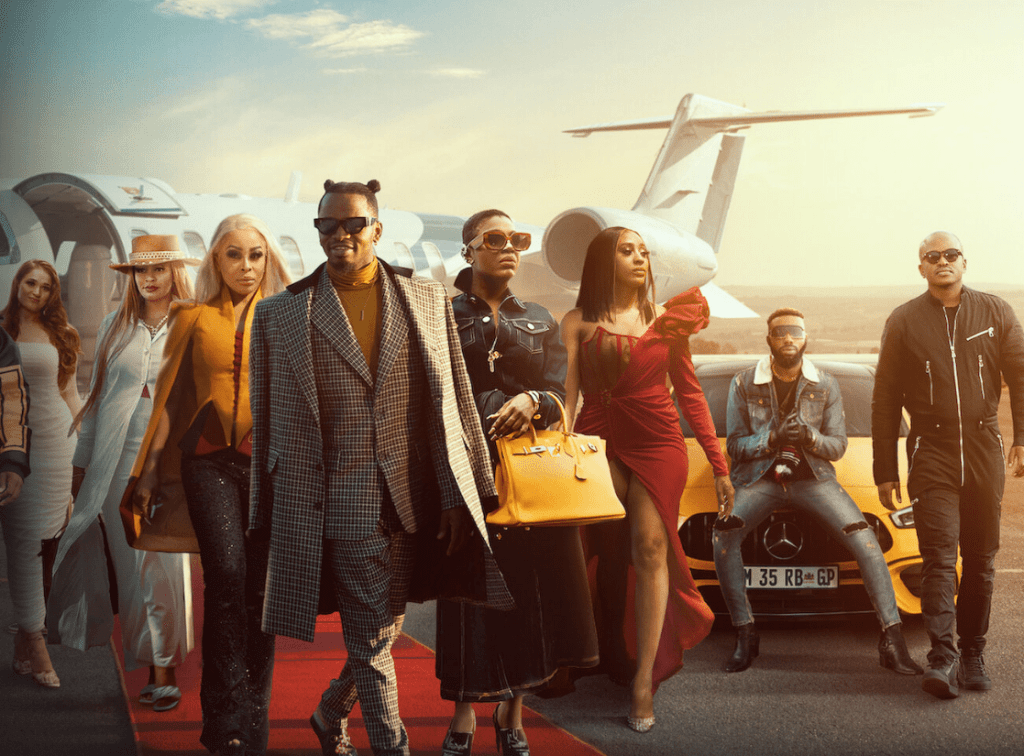
    YFA premiered on Netflix in March 2022, with a second season coming out in May 2023. The show follows a group of wealthy African individuals: celebrities, media personalities and businesspeople as they go about their lives in Johannesburg, South Africa. It is important to mention that nearly half of the cast do not live in South Africa full time (and are not of South African origin). Different African countries are represented including South Africa, where the show is filmed, Namibia, Ghana, Nigeria, Tanzania and Uganda.

    The show starts with one cast member planning a party. She says, “we’re celebrating the continent because it is our time and we want the world to know that we’re also as ‘first world’, even though they call us the third world.” This party, a “flex night” as she calls it, sets the narrative for the rest of the show.

    In both seasons of YFA the viewer is presented with a one-dimensional view of African wealth. Despite coming from different countries, cast members’ display and use of wealth seems rather samey and uninspired: expensive real estate in Johannesburg, lavish parties, boat rides, brunches with no real purpose other than drama, private jets, extravagant (and sometimes impractical) outfits, and Western designer clothing and accessories. It’s considered a negative thing if you can’t keep up. In one scene in season 2, two cast members get into an argument and one accuses the other of wearing fake designer items and not being as rich as she claims.

    This fixation on wealth and luxury, as Jade Bentil wrote, is “in service of securing the terrain for Black capitalist possibilities and futures.” The end goal (becoming rich) is idealized to the point that nothing else matters. The how-tos and the daily challenges of making money as an African artist or businesswoman in a deeply patriarchal society are never explored – not even superficially. This is becoming a major flaw in our society that celebrates capitalistic success through net worth lists and Instagram followings without paying too much attention to the means of obtaining such wealth: exploited and underpaid workers (including children) in factories and mines in developing countries, ever-increasing carbon emissions, and tax evasion through loopholes and offshore accounts.

    Wakandafication is primarily a media-related term and the concept it explains is likely to continue to dominate Afro-centered media in the near future. Shows like YFA validate black/African capitalistic ambitions among young Africans in the continent and those in the diaspora while simultaneously profiting off African cultures presented in an inauthentic or exaggerated way. While I’m excited about more Africa-focused content in international media, I’m ambivalent about feeding into this type of representation that is likely to have negative consequences in the long run.

  • Watch more movies.

    Watch more movies.

    Last year I re-discovered my love for movies. Back in high school I went off the radar during one school break and I watched at least 2 movies per night for an entire month. This was in 2015: good times (only when I watched stuff: I was extremely depressed). Movies helped me escape the cruel realities of the world that my mind had created, and also some of the realities of the actual world. Life was dreadful and I wanted nothing more than to escape.

    I fell in love with movies so much that I made handwritten lists. I think I still have them somewhere in one of the envelopes in my bottom drawer. Yes, I brought them with me to Germany. I made multiple lists of movies that I wanted to see in the coming years. I was inspired by this incredible list by TimeOut. I believe I’ve seen most of the movies in my lists, but I got lazy once I moved to Germany (p-wording is illegal here). I’ve watched great movies here and there in the last five years, but I haven’t been consistent. The one time I briefly re-discovered this hobby was during the first lockdown in Winter/Spring 2020. I even participated in this video by @LostInFilm. You can hear my voice from 1:51 over a clip from one of my all-time favorites, Before Sunrise.

    In 2022, I made it my personal mission to get back into the movies game. I don’t think I’ve succeeded in the way I wanted to, but for the first time in a long time I felt strong emotions when watching a movie. It was the movie CODA, which also won Best Picture at the 2022 Oscars. I simply clicked on it out of curiosity and wasn’t really expecting to love it so much but wow. It’s a story of a teenage girl born into an all-deaf family but only she can hear, and sing quite well. It’s a story about the struggles that deaf people go through just to be able to do basic things like earn a living and on top of that it’s a beautiful story of family love. One moment in particular made me cry because I realized that even though our circumstances as human beings differ, we all share the ability to feel love for others. 5 stars from me. I strongly encourage you to watch this incredible film.

    Bong Joon-ho during his acceptance speech for the Best Picture award at the 2020 Oscars.

    CODA is just one example of many amazing movies across different genres. Movies are simply a beautiful form of art. I could watch them all day if I had the time. It brings me the same feeling I get when I read a really great book (read An Absolutely Remarkable Thing by Hank Green). I challenge you, dear reader, to watch more movies this year (check out my Letterboxd for some suggestions). Allow yourself to experience new things and possibly get lost on Wikipedia trying to figure out if the actor on your screen is the same one from that other movie from the 90s that you watched more than 7 years ago because they just look so similar. As you look for new realities to experience, also remember that great movies are not exclusive to Hollywood or other Western film industries. There are thousands of stories and beautiful worlds out there that you may never get to know if you’re unwilling to read subtitles. Where do you find these? Start here.

    Header image is from CODA (2021, Apple TV+)